
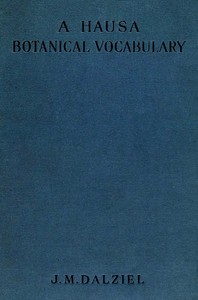
A Hausa botanical vocabulary by J. M. Dalziel
Let's be clear from the start: this is not a book you read cover-to-cover for plot. A Hausa Botanical Vocabulary is exactly what its title promises. Compiled by John McEwen Dalziel, a doctor and colonial officer stationed in what was then Northern Nigeria, it's a systematic list. Each entry gives a plant's scientific name, its Hausa name (or names), and then, crucially, its uses—medicinal, practical, ceremonial, or nutritional.
The Story
The 'story' here is in the gathering. Imagine Dalziel, between 1910 and 1930, traveling, consulting with local experts—healers, farmers, elders—and carefully writing down what they told him. The book organizes this oral, practical knowledge into the Western scientific structure of genus and species. One minute you're reading about a tree used for carving bowls, the next about a leaf that eases fever, or a seed that's a potent poison. It's a catalog of survival, culture, and deep environmental understanding, all filtered through the lens of early 20th-century botany and colonialism.
Why You Should Read It
I love this book for its layers. On one level, it's an incredible resource for anyone interested in ethnobotany or West African history. But on another, it's a deeply human document. You can feel the effort to get it right. In an era often defined by extraction and dismissal, this work represents a genuine attempt to listen and preserve. It acknowledges the sophistication of Hausa knowledge on its own terms. Dipping into it feels like overhearing fragments of a thousand different conversations about health, food, craft, and spirituality. It turns a simple list into a portal.
Final Verdict
This is a book for the curious and the patient. It's perfect for history buffs who want to go beyond kings and battles into the texture of daily life, for gardeners and plant lovers with a global perspective, or for writers seeking authentic detail. It's not a beach read, but a slow, rewarding exploration. Think of it as a reference book with a soul, a quiet testament to the fact that some of the most important stories aren't told in paragraphs, but in the names we give the growing world around us.
You are viewing a work that belongs to the global public domain. Preserving history for future generations.
Sarah Garcia
6 months agoThe digital formatting makes it very easy to navigate.
James Jackson
1 year agoThis is now a staple reference in my professional collection.
John Davis
10 months agoMy first impression was quite positive because the way it handles controversial points with balance is quite professional. It definitely lives up to the reputation of the publisher.
Barbara Williams
1 month agoGreat value and very well written.

Barbara Gonzalez
1 year agoA must-have for graduate-level students in this discipline.