
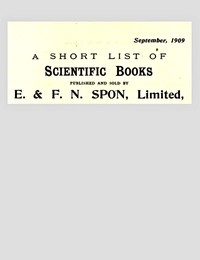
A Short List of Scientific Books Published and Sold by E. & F. N. Spon,…
Let's be clear from the start: this is not a storybook. There are no characters, no plot twists, and definitely no dialogue. 'A Short List of Scientific Books Published and Sold by E. & F. N. Spon' is a trade catalog from 1868. It's a simple list of textbooks, manuals, and reference works that this London publisher had for sale.
The Story
The 'story' is in the inventory itself. Page after page, it lists titles on everything from practical engineering and architecture to chemistry, metallurgy, and mathematics. You'll find manuals on building railways, designing drainage systems, analyzing gases, and working with iron. It's the syllabus for the Industrial Revolution. Each entry is a clue. A book on 'The Steam Engine' tells us what power sources were dominant. A guide for 'Clerks of Works' shows the need for on-site technical managers. A volume on 'Sanitary Engineering' hints at the growing public health concerns of crowded cities. Reading this list is like assembling a ghostly library, book by book, that defined professional knowledge for an entire generation of builders, inventors, and thinkers.
Why You Should Read It
I found this utterly absorbing for one reason: it makes history tangible. Textbooks often tell us *what* happened. This catalog shows us *how* it happened—what tools, both mental and physical, people were actually using. It strips away the romance and gets down to brass tacks (literally, there are probably books on metallurgy in here). You get a sense of the era's priorities. The sheer number of engineering manuals screams of a world under construction. The specificity—books on lighthouse construction, gas fitting, telegraphy—paints a picture of a society rapidly specializing. It's a quiet, powerful reminder that progress is built on a foundation of very detailed, often unglamorous, knowledge.
Final Verdict
This is a niche gem, but a brilliant one. It's perfect for history buffs, especially those interested in the Victorian era, the history of science, or the Industrial Revolution. It's also great for anyone who loves 'found' objects or seeing the world through an unusual lens. You won't get a narrative, but you will get a profound connection to the practical minds of the past. Think of it as an archaeological dig in book form. If you've ever browsed a weirdly specific manual at a used bookstore and wondered about its original owner, this entire catalog is that feeling, multiplied by a hundred. Approach it with curiosity, and it will reward you with a unique glimpse into the engine room of history.
This text is dedicated to the public domain. Use this text in your own projects freely.
Jessica Miller
7 months agoHaving explored several resources on this, I find that the author’s unique perspective adds a fresh layer to the discussion. I am looking forward to the author's next publication.
Charles Gonzalez
6 months agoThis is an essential addition to any academic digital library.
Matthew Hernandez
1 year agoI was particularly interested in the case studies mentioned here, the emphasis on ethics and sustainability within the topic is commendable. A solid investment for anyone's personal development.
David Hernandez
2 years agoIt’s rare to find such a well-structured narrative nowadays, the attention to detail regarding the core terminology is flawless. This has become my go-to guide for this specific topic.





Donald Anderson
6 months agoThe author provides a very nuanced critique of current methodologies.