
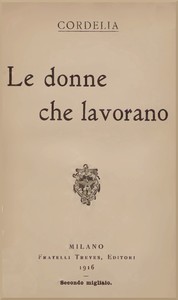
Le donne che lavorano by Virginia Treves
I stumbled upon this book almost by accident, and what a find it turned out to be. Published in 1888, Virginia Treves's Le donne che lavorano is a collection of observational essays that reads like a series of vivid, empathetic portraits.
The Story
There's no traditional plot with a beginning, middle, and end. Instead, Treves takes us on a tour of the female workforce in post-unification Italy. Each chapter focuses on a different profession. We meet the young seamstress working long hours in a dimly lit workshop, her eyes strained and her pay meager. We sit with the schoolteacher, respected but isolated, negotiating her place in a community. We see the shop assistant balancing politeness with the need to assert herself, and the factory worker facing grueling conditions. Treves presents their daily routines, their economic struggles, their small triumphs, and the social prejudices they constantly bump up against. It's less a story about them and more like we are quietly observing their lives.
Why You Should Read It
Here's what got me: the sheer modernity of it. Treves wasn't a distant sociologist; she wrote with a novelist's eye for detail and a deep sense of fairness. You feel the exhaustion of the women, but also their fierce pride and determination. She highlights the absurd double standard where work was a necessity for many women, yet doing it could somehow make them seem less 'proper.' Reading it, I kept having moments of recognition—the talk about low wages, lack of respect, and the struggle to balance life and work isn't confined to the 1880s. Treves gives history a heartbeat. These aren't just 'working women'; they are Lucia, Maria, and Carlotta, each with her own hopes and frustrations.
Final Verdict
This book is a hidden gem. It's perfect for anyone interested in women's history, social history, or just great narrative nonfiction that puts you right in another time and place. If you liked the feel of books that explore everyday life in the past, or if you're fascinated by the long road of women's rights, you'll connect with this immediately. It's a short, compelling reminder that the conversations we have today about work, value, and equality have very deep roots. A truly insightful and human read.
The copyright for this book has expired, making it public property. You do not need permission to reproduce this work.
William Thompson
5 months agoComparing this to other titles in the same genre, the way it challenges the status quo is both daring and well-supported. A solid investment for anyone's personal development.
Christopher Miller
3 months agoExtremely helpful for my current research project.
George Brown
1 month agoAs a long-time follower of this subject matter, the argument presented in the middle section is particularly compelling. I feel much more confident in my knowledge after finishing this.
Sarah Johnson
5 months agoIt’s rare to find such a well-structured narrative nowadays, the way the author breaks down the core concepts is remarkably clear. I'll be citing this in my upcoming project.


Christopher Martinez
11 months agoFinally found a version that is easy on the eyes.