
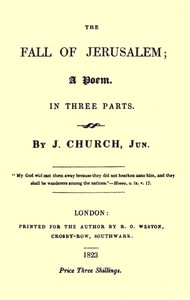
The Fall of Jerusalem: A Poem by Jr. John Church
John Church Jr.'s The Fall of Jerusalem isn't your typical history lesson. Written as a long narrative poem, it takes one of the ancient world's most pivotal sieges and makes it feel immediate and human.
The Story
The poem follows the final, brutal Roman siege of Jerusalem in 70 AD. We see the event through shifting perspectives. There's Titus, the future emperor, who is practical, weary, and under pressure to end the rebellion. Then, inside the city walls, we meet Jewish defenders and civilians—zealots arguing for fight-to-the-death resistance, families just trying to survive, and leaders facing impossible decisions. The narrative builds the tension not just of the battle, but of the internal conflicts tearing the city apart even before the first battering ram hits the gate. The climax isn't just the fall of the walls, but the collapse of hope and the scattering of a people.
Why You Should Read It
What got me was how Church makes you feel the weight of history without drowning you in details. He's less interested in troop movements and more in the moment a soldier looks at a burning temple and wonders what it was all for. The poetic form is accessible—think more like dramatic storytelling than old-fashioned rhyme. It gives the whole tragedy a rhythm and a gravity that prose sometimes misses. You come away understanding that this wasn't just a military victory and loss; it was a profound human catastrophe that changed the world. It makes you think about faith, fanaticism, and what we cling to when there's nothing left.
Final Verdict
Perfect for anyone who finds history fascinating but finds textbooks a snooze. If you enjoyed the character-driven drama of books like I, Claudius or the epic, tragic feel of films like Gladiator, this poem will be right up your alley. It's also a great pick for readers who want to try poetry but are intimidated by abstract modern works—this is poetry with a clear, gripping story at its heart. A compelling and surprisingly quick read about resilience and ruin.
This historical work is free of copyright protections. Use this text in your own projects freely.
Richard Martinez
10 months agoI had low expectations initially, however the flow of the text seems very fluid. A true masterpiece.
Jackson Miller
1 year agoSimply put, the arguments are well-supported by credible references. I couldn't put it down.
Jennifer Clark
1 year agoAfter finishing this book, the author's voice is distinct and makes complex topics easy to digest. Definitely a 5-star read.