About 362 minutes
Blanche: A Story for Girls — Inside the Classic
Historical Psychological Social Fiction
83,034 recorded words. 55 minutes difference from this book's estimate.
View Gutenberg source #43125
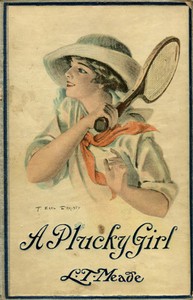
For A Plucky Girl — Themes and Context, the stored edition analysis reports 95,810 words, 6 hr 57 min estimated reading time, and 9 detected text sections.
The text analysis averages about 15.9 words per sentence, while the detected sections provide another way to judge how the source is divided.
Project Gutenberg metadata also associates the work with “Love stories,” connecting these edition facts with the source record’s subject description.
Explore this collection
These alternatives are selected using recorded categories and estimated reading time.
About 362 minutes
Historical Psychological Social Fiction
83,034 recorded words. 55 minutes difference from this book's estimate.
View Gutenberg source #43125About 362 minutes
Historical Psychological Social Fiction
83,238 recorded words. 55 minutes difference from this book's estimate.
View Gutenberg source #42681About 346 minutes
Historical Psychological Social Fiction
79,367 recorded words. 71 minutes difference from this book's estimate.
View Gutenberg source #46909Search stored excerpts and compare books → Choose by your preferences →
Choices use stored catalog measurements. Estimates vary with reading speed. A shared category is a catalog label, not a claim that two books have the same argument or literary quality.
Search reads excerpt text stored with this catalog and links to its associated Gutenberg record. The connection is stored in the site database; this tool does not recheck that every excerpt is word-for-word identical to that external record. Excerpt search does not cover every chapter and does not verify historical publication dates.
Catalog snapshot checked: 2026-09-26. Coverage: 97 public books, 97 available source excerpts.
Calculated from edition completeness, EPUB availability, text structure and catalogue metadata. Not a user rating.
Total of 100 points, scaled to a 2.5-5.0 range. Editions with an empty description or a missing EPUB file are not scored.
Public-domain source text
The source text is kept in the dedicated reader, separate from this catalogue record and its commentary.
The narrator, Westenra Wickham, introduces herself by her unusual name—her mother gave her the full name of her father, a Major-General killed in Zululand. The opening chapter establishes a household defined by loss and devotion: the mother speaks of her dead husband as if he were still present, and the daughter grows up with a passionate attachment to his memory. The catalog subjects list boardinghouses and mothers and daughters, but the excerpts show that the boardinghouse is a scheme devised by Westenra to support herself and her ailing mother after they lose their Mayfair home. The story’s emotional weight falls on financial anxiety, withheld information, and the narrator’s determination to appear cheerful while privately grieving.
Westenra Wickham is named after her father, John Westenra Wickham, and the name becomes a marker of her identity. She reports that people commented on it as she grew up, and her mother pronounced it slowly, with evident love. The father died a month before her birth, yet the household is saturated with his presence: the mother tells stories of his bravery, his Victoria Cross, and his death rescuing a brother-officer. The narrator says she grew up with a “great passionate affection” for her dead father and pride in his memory. This framing does more than establish backstory—it positions Westenra as someone who must live up to a heroic ideal. The catalog subject “Mothers and daughters” is accurate, but the excerpts reveal that the mother-daughter bond is mediated by the absent father’s legend, and that the daughter’s pluck may be partly an effort to embody his courage.
The excerpts contain multiple layers of withheld information. Jim Randolph, a friend of the family, tells Westenra he must leave England due to “unexpected calamity” but refuses to explain. He admits that her mother knows “something but not all,” and that the servant Jane knows the full secret. Westenra presses him: “It is unfair on me to keep me in the dark.” He promises to tell her when he returns. Meanwhile, Dr. Reade’s words about her mother’s health “begin to hurt,” and Westenra plans to wait until night to give way to grief. The boardinghouse, which the catalog lists as a subject, is not described in detail in these excerpts, but it is clearly the setting for much of the action. The emphasis falls on the strain of maintaining appearances—Westenra buys flowers and dainties for her mother, laughs heartily, and hides her unhappiness. The story’s tension arises less from romance than from the threat of financial ruin and the burden of undisclosed truths.
Westenra’s narration is marked by controlled emotion and a vocabulary of duty. She speaks of “keeping up” and not breaking down, of “the long blessed hours” when she can let her grief overpower her. When Jim Randolph says he must trust her, she replies with questions but ultimately accepts his secrecy. The prose is direct, with short sentences and frequent use of dashes to convey hesitation or urgency. The word “plucky” in the title is never used in the excerpts, but the narrator’s actions—taking on commissions for Jane, cheering her mother, facing the doctor’s prognosis alone—embody the quality. The catalog subject “Love stories” may apply to the full novel, but the excerpts show no romantic development; instead, the emotional core is the daughter’s struggle to manage fear and sorrow while projecting strength. The setting in London’s boardinghouse world is evoked through small details: the Square garden, the dinner-time errands, the “little special dainty” bought for mother.
Readers should attend to the gaps in what Westenra knows versus what the reader suspects. The novel’s suspense depends on secrets kept by Jim Randolph, Jane, and even the mother. The boardinghouse is not merely a setting but a precarious enterprise, and the narrator’s voice—resolute yet vulnerable—carries the story. The catalog subjects provide a starting point, but the excerpts suggest a narrative more concerned with financial peril and filial duty than with romance.
That rainy Tuesday, I kept returning to Westenra's ledger, her quiet arithmetic of survival. When the last page turned, I sat there, not wanting to leave that particular twilight. On a whim, some damp yarn stirred inside me. I found myself drifting to The Adopting of Rosa Marie (A Sequel to Dandelion Cottage), and those girls’ careful, hopeful household felt like the same stubborn warmth, just a different kind of roof.
Build a private reading journal entry for this title.