About 331 minutes
Under King Henry's Banners: A story of the days of Agincourt — Story, Setting & Ideas
Historical Psychological Social Fiction
76,088 recorded words. 15 minutes difference from this book's estimate.
View Gutenberg source #55364
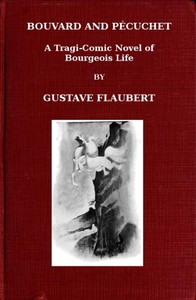
Bouvard and Pécuchet: A Tragi-comic Novel of Bourgeois Life, part 2 — A Reader’s Guide can be approached with a clearer sense of reading commitment from its source measurements: 79,367 words, 5 hr 46 min estimated reading time, and 8 detected text sections.
The text analysis averages about 17.0 words per sentence, while the detected sections provide another way to judge how the source is divided.
Project Gutenberg metadata also associates the work with “France -- Social life and customs -- 19th century -- Fiction,” connecting these edition facts with the source record’s subject description.
Explore this collection
These alternatives are selected using recorded categories and estimated reading time.
About 331 minutes
Historical Psychological Social Fiction
76,088 recorded words. 15 minutes difference from this book's estimate.
View Gutenberg source #55364About 362 minutes
Historical Psychological Social Fiction
83,034 recorded words. 16 minutes difference from this book's estimate.
View Gutenberg source #43125About 362 minutes
Historical Psychological Social Fiction
83,238 recorded words. 16 minutes difference from this book's estimate.
View Gutenberg source #42681Search stored excerpts and compare books → Choose by your preferences →
Choices use stored catalog measurements. Estimates vary with reading speed. A shared category is a catalog label, not a claim that two books have the same argument or literary quality.
Search reads excerpt text stored with this catalog and links to its associated Gutenberg record. The connection is stored in the site database; this tool does not recheck that every excerpt is word-for-word identical to that external record. Excerpt search does not cover every chapter and does not verify historical publication dates.
Catalog snapshot checked: 2026-09-26. Coverage: 97 public books, 97 available source excerpts.
Calculated from edition completeness, EPUB availability, text structure and catalogue metadata. Not a user rating.
Total of 100 points, scaled to a 2.5-5.0 range. Editions with an empty description or a missing EPUB file are not scored.
Public-domain source text
The source text is kept in the dedicated reader, separate from this catalogue record and its commentary.
The second part of Flaubert's unfinished novel opens with Bouvard and Pécuchet, after a narrow escape from death, experiencing a rare moment of serenity. The snow has melted, and they walk in the garden, 'delighted merely with living.' This fragile contentment leads them to pious reading: the Gospel 'dilated their souls, dazzled them like a sun.' Yet Flaubert's irony is never far—their religious fervor is as naive as their earlier enthusiasms. They see in Jesus only 'His tenderness for the humble, His defence of the poor,' and find 'nothing theological' in the Book. This selective, sentimental piety is a prelude to further disillusionment.
When the two copyists turn to religion, they do so with characteristic literalness. The Gospel 'dilated their souls, dazzled them like a sun'—a simile that suggests both illumination and blindness. They imagine Jesus 'standing on a mountain, with one arm raised,' or 'on the margin of a lake,' or 'lifted high upon the Cross.' These are vivid tableaux, not theological insights. Flaubert notes that 'their reason was not astonished' by miracles; they accept everything with a credulity that mirrors their earlier scientific gullibility. The narrator's dry observation—'they found in that Book, wherein Heaven unfolds itself, nothing theological'—underscores their inability to grapple with dogma. Their faith is a sentimental attachment to images of humility and oppression, not a coherent belief system. This episode prefigures their eventual abandonment of religion, just as they abandoned agriculture, chemistry, and medicine.
Included in this volume is Flaubert's Letter to the Municipality of Rouen, a separate polemic that nonetheless echoes the novel's themes. The letter attacks the municipal council for refusing to fund a fountain bearing the bust of the poet Louis Bouilhet. Flaubert's satire targets the bourgeois committee's paralysis: 'When the public clamours, a committee is at once appointed; and from that time nothing is done.' He mocks their stinginess—30,000 francs for a Napoleon statue, but only 7,037.38 for a statue of Corneille, and nothing for Bouilhet. The letter's refrain, 'always the committee!', becomes a comic motif. Flaubert accuses the bourgeoisie of having 'the feelings of the rabble' and predicts their end. This document, with its specific figures and quoted newspaper reactions, offers a real-world counterpart to the novel's fictional critiques of mediocrity and inertia.
The novel's second part continues the pattern established in the first: each new enthusiasm—religion, art, science—leads to disappointment. The excerpts show Bouvard and Pécuchet moving from Gospel reading to a 'Conference' on art and science, but the trajectory is clear. Flaubert's plan, included as an extract, indicates the work's conclusion: the two heroes return to copying, their original occupation. This circular structure is the novel's deepest irony. The 'Tragi-comic' subtitle is earned not through plot twists but through the relentless repetition of failure. The reader watches the protagonists cycle through disciplines, each time believing they have found the key, only to be thwarted by their own incompetence or the world's indifference. Flaubert's method is accumulative: the specific details of each failure—the lump on Marcel's forehead, the 7,037.38 francs—build a world where nothing succeeds.
Readers approaching this second part should attend to Flaubert's use of repetition and variation. Each new subject—religion, art, municipal politics—receives the same treatment: initial enthusiasm, comic mishap, and quiet defeat. The inclusion of the Letter to the Municipality of Rouen is not an appendix but a key: it shows Flaubert's satirical method applied to real events, with the same targets (mediocrity, committees, false economy) that animate the novel. Watch how the prose shifts between lyrical description and deadpan reportage; that tension is the book's engine.
After all these years among the stacks, I still ponder Bouvard and Pécuchet's restless futility, how their grand pursuits crumble into quiet absurdity. It reminds me sometimes of The Corner House Girls How they moved to Milton, what they found, and what they did — Background and Themes, where simpler folk find meaning not in great systems, but in daily, modest struggles. Different worlds, yet both whisper of our shared, stumbling humanity.
Build a private reading journal entry for this title.