About 362 minutes
Blanche: A Story for Girls — Inside the Classic
Historical Psychological Social Fiction
83,034 recorded words. 0 minutes difference from this book's estimate.
View Gutenberg source #43125
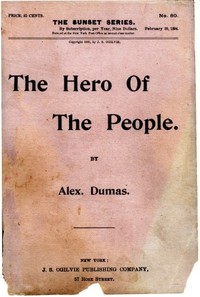
Before opening The Hero of the People: A Historical Romance of Love, Liberty and Loyalty — Themes and Context, the edition data offers a quick orientation: 83,238 words, 6 hr 2 min estimated reading time, and 9 detected text sections.
The text analysis averages about 17.3 words per sentence, while the detected sections provide another way to judge how the source is divided.
Project Gutenberg metadata also associates the work with “Historical fiction,” connecting these edition facts with the source record’s subject description.
Explore this collection
These alternatives are selected using recorded categories and estimated reading time.
About 362 minutes
Historical Psychological Social Fiction
83,034 recorded words. 0 minutes difference from this book's estimate.
View Gutenberg source #43125About 346 minutes
Historical Psychological Social Fiction
79,367 recorded words. 16 minutes difference from this book's estimate.
View Gutenberg source #46909About 331 minutes
Historical Psychological Social Fiction
76,088 recorded words. 31 minutes difference from this book's estimate.
View Gutenberg source #55364Search stored excerpts and compare books → Choose by your preferences →
Choices use stored catalog measurements. Estimates vary with reading speed. A shared category is a catalog label, not a claim that two books have the same argument or literary quality.
Search reads excerpt text stored with this catalog and links to its associated Gutenberg record. The connection is stored in the site database; this tool does not recheck that every excerpt is word-for-word identical to that external record. Excerpt search does not cover every chapter and does not verify historical publication dates.
Catalog snapshot checked: 2026-09-26. Coverage: 97 public books, 97 available source excerpts.
Calculated from edition completeness, EPUB availability, text structure and catalogue metadata. Not a user rating.
Total of 100 points, scaled to a 2.5-5.0 range. Editions with an empty description or a missing EPUB file are not scored.
Public-domain source text
The source text is kept in the dedicated reader, separate from this catalogue record and its commentary.
The novel opens not with a battle or a crowd but with a king confiding in a trusted subject. Louis XVI’s speech to the Count of Charny, excerpted here, reveals a monarch who dissects his own political traps—Austrian influence, the Favras plan, his brother’s ambitions—with a bitterness that undercuts any romanticized view of royalty. The king’s voice is precise, weary, and calculating: he speaks of “the hand of Austria beckoning me into a trap” and dismisses his wife’s hairdresser and dressmaker as pensioned counselors. This early scene establishes a pattern of intimate political negotiation that will likely recur throughout the novel.
The excerpt from Chapter I is dominated by Louis XVI’s monologue to Charny. The king lists grievances—Austria’s extortions, the Archbishop of Toulouse, the hairdresser Léonard—in a tone that blends self-pity with sharp analysis. He admits he has “thought of this flight before” but recoiled from Austrian overtures. This confession serves as a concentrated dose of the novel’s political context: the monarchy’s isolation, the queen’s contested loyalty, and the threat of a regency under the king’s brother. Dumas uses the scene to plant key names (Favras, Breteuil, Necker) and to foreshadow the central dilemma of escape versus entrapment. For a first reader, this passage functions as a compressed briefing on the historical moment, delivered through character rather than exposition.
The chapter title “Locksmith and Gunsmith” hints at a symbolic pairing that the excerpt does not fully develop. The opening pages describe the taking of the Bastille on July 14, 1789, but quickly shift to the king’s private council. The two trades—one associated with securing doors, the other with opening fire—may represent opposing forces within the revolution: containment versus violence. Dumas’s habit of using professional contrasts (as in The Three Musketeers) suggests that these figures will reappear as embodiments of different revolutionary paths. The reader should watch for how the locksmith’s skill (perhaps literal lock-picking or key-making) and the gunsmith’s trade intersect with the plot of flight and pursuit.
Marie Antoinette is a catalog subject but barely appears in the excerpt. The king mentions her only indirectly, stressing that he has told Charny things he has not told “even the Queen.” He lays stress on the words “not even the Queen,” signaling a rift or a protective silence. The queen’s hairdresser and dressmaker are named as conduits of Austrian influence, yet she herself is absent from the conversation. This lacuna may be deliberate: Dumas may be reserving her voice for later scenes, or using her as a figure whose loyalty is questioned by others. A first reader should note that the queen’s role is defined by others’ perceptions—Austrian, frivolous, or manipulated—rather than by her own actions in this opening.
The king outlines two escape schemes: the Austrian proposal and the Favras plan, the latter backed by his brother, the Count of Provence. He dismisses the Austrian route as a trap and characterizes Favras as “a brave soldier and a loyal gentleman” but “fit for mad projects.” The count of Charny is given the scissors and thread—to “disentangle or cut” as he sees fit. This metaphor of tailoring suggests that the plot will involve intricate adjustments, false leads, and last-minute alterations. The reader is primed for a narrative of conspiracy where no plan is straightforward, and where trust is parceled out sparingly. The king’s warning that “all know” about the possibility of a regency adds a layer of public knowledge that complicates any secret maneuver.
These excerpts offer a narrow but dense window into Dumas’s method: he embeds historical exposition in tense dialogue, uses craft titles as thematic clues, and withholds key characters to build suspense. A first reader will benefit from tracking the king’s shifting alliances, the symbolic weight of trades, and the gradual emergence of the queen’s perspective. The novel’s title promises a hero, but the opening suggests that heroism may be a matter of loyalty tested by conspiracy rather than battlefield glory.
There’s something comforting in watching a plot unfold slowly, the way Dumas lets secrets breathe—and I found that same patient hand in Dreadnoughts of the Dogger: A Story of the War on the North Sea — Edition Insights, where the sea waits too, quietly. Both feel less like stories and more like old friends recounting things they’ve carried a long time.
Save your reaction, strongest insight, and memorable passage.