About 540 minutes
Brother Jacques (Novels of Paul de Kock, Volume XVII) — Background and Themes
Science Fiction Utopias
124,059 recorded words. 92 minutes difference from this book's estimate.
View Gutenberg source #40913
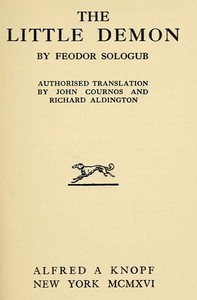
Before opening The Little Demon — Themes and Context, the edition data offers a quick orientation: 102,953 words, 7 hr 28 min estimated reading time, and 12 detected text sections.
The text analysis averages about 12.8 words per sentence, while the detected sections provide another way to judge how the source is divided.
Project Gutenberg metadata also associates the work with “Teachers -- Fiction,” connecting these edition facts with the source record’s subject description.
Explore this collection
These alternatives are selected using recorded categories and estimated reading time.
About 540 minutes
Science Fiction Utopias
124,059 recorded words. 92 minutes difference from this book's estimate.
View Gutenberg source #40913About 322 minutes
Science Fiction Utopias
73,946 recorded words. 126 minutes difference from this book's estimate.
View Gutenberg source #43993About 303 minutes
Science Fiction Utopias
69,531 recorded words. 145 minutes difference from this book's estimate.
View Gutenberg source #46343Search stored excerpts and compare books → Choose by your preferences →
Choices use stored catalog measurements. Estimates vary with reading speed. A shared category is a catalog label, not a claim that two books have the same argument or literary quality.
Search reads excerpt text stored with this catalog and links to its associated Gutenberg record. The connection is stored in the site database; this tool does not recheck that every excerpt is word-for-word identical to that external record. Excerpt search does not cover every chapter and does not verify historical publication dates.
Catalog snapshot checked: 2026-09-26. Coverage: 97 public books, 97 available source excerpts.
Calculated from edition completeness, EPUB availability, text structure and catalogue metadata. Not a user rating.
Total of 100 points, scaled to a 2.5-5.0 range. Editions with an empty description or a missing EPUB file are not scored.
Public-domain source text
The source text is kept in the dedicated reader, separate from this catalogue record and its commentary.
The translation of The Little Demon by Richard Aldington and John Cournos presents a narrative that oscillates between the claustrophobic interiority of its protagonist, Peredonov, and moments of lighter, almost theatrical dialogue. The translators' preface notes the novel's merging of comedy with tragedy, a fusion evident in the pacing: long, tense passages of Peredonov's paranoid reflections are punctuated by brisk, playful exchanges among other characters. This rhythm creates a disorienting effect, drawing the reader into Peredonov's skewed perception while offering brief respites that underscore the pettiness of his world.
The narrative frequently filters the world through Peredonov's consciousness, distorting objects and people into symbols of his inner turmoil. In one passage, he reflects on the name "Liutiki," noting its root meaning "cruel, ferocious, violent"—a detail that reveals his tendency to project menace onto innocuous things. This subjective treatment is not consistent; the novel shifts to a more detached, observational tone when depicting other characters, such as the playful banter between Nadezhda and Misha. The contrast highlights Peredonov's isolation: while others engage in lighthearted rituals, his mind turns everything into a threat. The translators preserve this oscillation by alternating between dense, interior prose and crisp dialogue, mirroring the protagonist's erratic mental state.
The Sasha-Liudmilla episode, described in the preface as "a dab of vermilion relieves grey," introduces a marked shift in pace. Liudmilla's preparations—dressing gaily, scenting herself with syringa perfume, and carrying a bottle of scent to mask the boy's "detestable Latin, ink and boyishness"—unfold in leisurely, sensory detail. The narrative lingers on her actions, creating a pause from Peredonov's frantic suspicions. However, this idyll is undercut by the awareness that it occurs within the same oppressive atmosphere. The translators maintain this tension by using longer, flowing sentences for Liudmilla's scenes, contrasting with the staccato rhythms of Peredonov's sections. The effect is a deliberate unevenness that prevents the reader from settling into a single mood.
The translators' preface explicitly compares the novel to Gogol's Dead Souls, and the translation echoes Gogol's blend of satire and sympathy. The dialogue, particularly among the younger characters, carries a colloquial energy—Misha's exclamation "Pavloushka's bride!" and the siblings' teasing retain a naturalistic cadence. In contrast, Peredonov's internal monologues are rendered in a more formal, almost stilted English, emphasizing his alienation. The translators also preserve cultural specifics, such as the reference to "birching," without explanatory gloss, trusting the reader to infer the social context. These choices create a layered voice: the novel speaks in multiple registers, from the mundane to the grotesque, without flattening the original's tonal complexity.
Readers attentive to shifts in tempo will find that the novel's power lies in its unevenness—the way it lurches from Peredonov's obsessive spirals to the brittle gaiety of provincial life. The translation by Aldington and Cournos captures this disquieting rhythm, making the work as much a study in narrative pacing as in character. Approach the text with an ear for its changes in speed and tone; they are as telling as any explicit plot development.
Some afternoons, I think of Peredonov’s trembling unease, how Sologub’s pacing lets that dread breathe, and then my gaze drifts to Zola—that humming, bright department store where crowds blur into a different kind of fever. Both novels share a quiet kinship of consuming interiors, though one whispers madness and the other, appetite. It’s a strange companionship, but familiar. The Ladies' Paradise: A Realistic Novel — Context and Discussion rests beside such memories like an old friend.
Answer a few questions and save a private reflection on this device.