About 448 minutes
The Little Demon — Themes and Context
Science Fiction Utopias
102,953 recorded words. 92 minutes difference from this book's estimate.
View Gutenberg source #48912
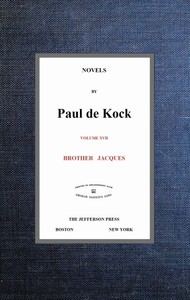
This digital edition of Brother Jacques (Novels of Paul de Kock, Volume XVII) — Background and Themes is described by source-level measurements including 124,059 words, 9 hr estimated reading time, and 12 detected text sections.
The text analysis averages about 20.4 words per sentence, while the detected sections provide another way to judge how the source is divided.
Project Gutenberg metadata also associates the work with “Paris (France) -- Fiction,” connecting these edition facts with the source record’s subject description.
Explore this collection
These alternatives are selected using recorded categories and estimated reading time.
About 448 minutes
Science Fiction Utopias
102,953 recorded words. 92 minutes difference from this book's estimate.
View Gutenberg source #48912About 716 minutes
Science Fiction Utopias
164,645 recorded words. 176 minutes difference from this book's estimate.
View Gutenberg source #54687About 732 minutes
Science Fiction Utopias
168,146 recorded words. 192 minutes difference from this book's estimate.
View Gutenberg source #52618Search stored excerpts and compare books → Choose by your preferences →
Choices use stored catalog measurements. Estimates vary with reading speed. A shared category is a catalog label, not a claim that two books have the same argument or literary quality.
Search reads excerpt text stored with this catalog and links to its associated Gutenberg record. The connection is stored in the site database; this tool does not recheck that every excerpt is word-for-word identical to that external record. Excerpt search does not cover every chapter and does not verify historical publication dates.
Catalog snapshot checked: 2026-09-26. Coverage: 97 public books, 97 available source excerpts.
Calculated from edition completeness, EPUB availability, text structure and catalogue metadata. Not a user rating.
Total of 100 points, scaled to a 2.5-5.0 range. Editions with an empty description or a missing EPUB file are not scored.
Public-domain source text
The source text is kept in the dedicated reader, separate from this catalogue record and its commentary.
The opening chapter of Brother Jacques plunges the reader into a wedding party at the Cadran-Bleu on the Boulevard du Temple, a setting that immediately establishes the novel's interest in Parisian social spectacle. The narrator directly addresses the reader, inviting them to observe the scene: 'Pause a moment on the boulevard, in front of the Cadran-Bleu; follow the example of those folk who look on at all the wedding parties.' This technique of drawing the reader into the crowd is characteristic of Paul de Kock's style, blending observation with commentary.
The excerpt reveals a narrative voice that is both intimate and ironic, reflecting on the gap between wedding-day hopes and later disappointments. The narrator muses on how the wedding ceremony 'saddens the young wife, but a few years married, who already has ceased to know happiness except in her memory.' This early passage sets a tone of worldly skepticism, hinting at the marital tensions and deceptions that may unfold.
The narrator of Brother Jacques is not a neutral observer but an active presence who questions, explains, and moralizes. In the opening pages, the narrator asks directly: 'But, you will ask me, what is the occasion of this assemblage at the Cadran-Bleu?' and then answers, 'Better than any of these; it is a wedding party.' This rhetorical device creates a conversational tone, as if the reader is being guided through the scene by a knowing companion.
The narrator also offers cynical reflections on marriage, noting that orange blossoms 'have unhappily lied to more than one husband who has never boasted about it.' Such asides reveal a narrator who is skeptical of romantic ideals and attuned to the gap between public ceremony and private reality. This voice is a consistent feature of the text, shaping how events and characters are presented.
A substantial portion of the excerpted dialogue concerns gambling, specifically the 'academy' at number 9 in the Palais-Royal, a roulette establishment. The character Dufresne describes it as a place where 'the most fashionable people' gather, including 'many nobles who try their hardest to win the money of plebeians.' The conversation reveals a world where social boundaries are porous: merchants, brokers, and soldiers mix with chevaliers and viscounts, all engaged in the pursuit of fortune.
The dialogue includes a quotation from a 'favorite author' that praises gambling as a means to a life of ease, listing 'Gascons loud who sup at game-house board' and 'unribboned knights.' This embedded verse suggests that gambling is not merely a pastime but a theme that the novel treats with both fascination and moral ambiguity. The characters' casual discussion of 'martingale' systems and 'recouping losses' indicates a culture where risk is normalized and even celebrated.
The novel's settings are carefully chosen to convey social status and atmosphere. The Cadran-Bleu, a restaurant on the Boulevard du Temple, is presented as a venue for wedding parties and public display, where 'idlers, the loiterers, or the loungers' gather to watch. The narrator describes the scene at midnight, when 'the tableau becomes more interesting, more varied, more animated,' emphasizing the performative nature of Parisian social life.
In contrast, the Palais-Royal's number 9 is a gambling den that Dufresne insists is 'almost as respectable as Frascati’s,' a famous gaming house. The distinction between number 9 and 'number 113'—the latter reserved for 'workmen, the apprentices, and the petty tradesmen'—shows how the novel uses specific addresses to map the city's social hierarchy. These locations are not just backdrops but active elements that define characters' aspirations and risks.
Readers approaching Brother Jacques should attend to the narrator's direct addresses and the way they frame the action. The excerpts suggest a novel that is as interested in the manners and morals of Parisian society as in its plot. The catalog subjects list 'Brothers' as a theme, but the excerpts do not yet reveal which character is the titular brother or how fraternal relationships drive the story. The gambling dialogue and wedding party setup, however, indicate a world where appearances are carefully managed and where money and marriage are intertwined.
There’s a particular ache in Brother Jacques when the gambling tables swallow a family’s quiet hopes, that same helpless feeling that haunts Ourika — Context and Discussion. Both books know how Paris shapes a person from the outside, leaving the inner life to grow crooked or still. I still think about those characters sometimes, like old neighbors.
Save your reaction, strongest insight, and memorable passage.