About 168 minutes
The Slipper Point Mystery — Reading Companion
Historical Psychological Social Fiction
38,596 recorded words. 85 minutes difference from this book's estimate.
View Gutenberg source #39900
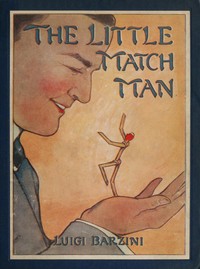
For The Little Match Man — Key Ideas to Explore, the stored edition analysis reports 18,881 words, 1 hr 23 min estimated reading time, and 25 detected text sections.
The text analysis averages about 13.0 words per sentence, while the detected sections provide another way to judge how the source is divided.
Project Gutenberg metadata also associates the work with “War -- Juvenile fiction,” connecting these edition facts with the source record’s subject description.
Explore this collection
These alternatives are selected using recorded categories and estimated reading time.
About 168 minutes
Historical Psychological Social Fiction
38,596 recorded words. 85 minutes difference from this book's estimate.
View Gutenberg source #39900About 198 minutes
Historical Psychological Social Fiction
45,536 recorded words. 115 minutes difference from this book's estimate.
View Gutenberg source #39896About 202 minutes
Historical Psychological Social Fiction
46,404 recorded words. 119 minutes difference from this book's estimate.
View Gutenberg source #46059Search stored excerpts and compare books → Choose by your preferences →
Choices use stored catalog measurements. Estimates vary with reading speed. A shared category is a catalog label, not a claim that two books have the same argument or literary quality.
Search reads excerpt text stored with this catalog and links to its associated Gutenberg record. The connection is stored in the site database; this tool does not recheck that every excerpt is word-for-word identical to that external record. Excerpt search does not cover every chapter and does not verify historical publication dates.
Catalog snapshot checked: 2026-09-26. Coverage: 97 public books, 97 available source excerpts.
Calculated from edition completeness, EPUB availability, text structure and catalogue metadata. Not a user rating.
Total of 100 points, scaled to a 2.5-5.0 range. Editions with an empty description or a missing EPUB file are not scored.
Public-domain source text
The source text is kept in the dedicated reader, separate from this catalogue record and its commentary.
The narrator's discovery of Fiammiferino—a living match who emerges from a matchbox—immediately establishes a world where the miniature and the mundane collide. The match's name, meaning 'little match' in Italian, hints at his combustible nature, a tension that runs throughout the story. Barzini grounds the fantasy in precise physical details: Fiam's box has a hole he uses to escape, and his scale turns a discarded waistcoat into 'mountains and valleys, ravines, plains, precipices and grottoes.'
The narrative voice is conspiratorial, opening with a direct address to the reader: 'I am going to tell you something that you must never tell any one.' This framing invites intimacy while acknowledging the implausibility of the tale. The setting—Japan during wartime—provides a backdrop of conflict that contrasts with Fiam's small-scale adventures.
Barzini repeatedly exploits the mismatch between Fiam's size and the human world. When the narrator loses Fiam in his waistcoat, the match describes his journey through folds as 'a long tunnel where I had to crawl on all fours.' A ripped pocket becomes a cave entrance, and a pocket full of paper is a 'cavern.' The narrator's watch sounds 'like a blacksmith's forge.' These descriptions force the reader to reimagine ordinary objects as alien terrain.
This perspective extends to the illustrations by Hattie Longstreet, which depict Fiam climbing buttons and peering over edges. The text and images together create a consistent scale where a matchstick figure navigates a world of giants. The narrator's inability to hear Fiam's screams when trapped in clothing underscores the vulnerability of the tiny protagonist.
The story is set against a war in Japan, but the conflict remains peripheral, glimpsed through the narrator's journey to join an army. Chapter titles like 'Fiam Goes to the War' and 'Fiam Overlooks the Battle' suggest the match's involvement, yet the excerpts show more concern with domestic mishaps—getting lost in clothes, hiding in a camera—than with combat. The war provides a reason for travel and a source of tension, but Barzini focuses on the absurdity of a match participating in human warfare.
In one scene, Fiam's shadow appears in photographs, revealing he is trapped inside the camera. This accidental discovery is more central to the plot than any battle. The war functions as a framing device, allowing the narrator to move through different locations while the real drama remains the match's survival against everyday hazards.
The narrator's tone is confiding and slightly defensive, anticipating disbelief: 'Stupid people wouldn't believe it, anyway.' This creates a partnership with the reader, who is implicitly trusted to accept the fantastic. The match himself has a distinct voice—formal, proud, and easily offended. When the narrator calls him 'stupid,' Fiam retorts that it is 'exactly opposite to the pure and simple truth' and refuses to speak for two hours.
This exchange reveals a character with dignity despite his size. The narrator's repeated searches and emotional reactions—'I would have given ten years of my life' to find Fiam—suggest a bond that transcends the implausible premise. The story's humor arises from the mismatch between the narrator's earnest concern and the match's petty grievances.
Readers should attend to the interplay between text and illustration, as Longstreet's images often depict moments not fully described in words. The episodic structure, with each chapter a self-contained adventure, makes the book suitable for reading aloud. Notice how Barzini balances the fantastical premise with concrete details—the ripped pocket, the camera, the postage stamps—that ground the story in a recognizable world. The war remains a distant rumble; the true conflict is between a man and a match who refuses to be ordinary.
That afternoon, rain blurred the window while Fiammiferino’s tiny world shrank mine to a tabletop—every crumb a boulder. The match’s fear felt almost familiar, a scale of worry I knew. Later, wandering the shelf, I found the quiet room of Nancy Brandon — Themes and Context and remembered that smallness isn’t always about size.
Save your reaction, strongest insight, and memorable passage.