About 250 minutes
With Mask and Mitt — Themes and Context
Science Fiction Utopias
57,362 recorded words. 1 minutes difference from this book's estimate.
View Gutenberg source #55896
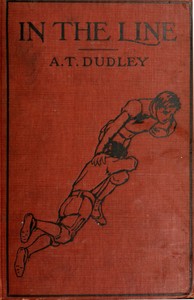
The catalog record for In the Line — Text and Context provides practical reading context through 57,696 words, 4 hr 11 min estimated reading time, and 29 detected text sections.
The text analysis averages about 16.7 words per sentence, while the detected sections provide another way to judge how the source is divided.
Project Gutenberg metadata also associates the work with “Schools -- Juvenile fiction,” connecting these edition facts with the source record’s subject description.
Explore this collection
These alternatives are selected using recorded categories and estimated reading time.
About 250 minutes
Science Fiction Utopias
57,362 recorded words. 1 minutes difference from this book's estimate.
View Gutenberg source #55896About 274 minutes
Science Fiction Utopias
62,995 recorded words. 23 minutes difference from this book's estimate.
View Gutenberg source #56215About 279 minutes
Science Fiction Utopias
64,107 recorded words. 28 minutes difference from this book's estimate.
View Gutenberg source #49414Search stored excerpts and compare books → Choose by your preferences →
Choices use stored catalog measurements. Estimates vary with reading speed. A shared category is a catalog label, not a claim that two books have the same argument or literary quality.
Search reads excerpt text stored with this catalog and links to its associated Gutenberg record. The connection is stored in the site database; this tool does not recheck that every excerpt is word-for-word identical to that external record. Excerpt search does not cover every chapter and does not verify historical publication dates.
Catalog snapshot checked: 2026-09-26. Coverage: 97 public books, 97 available source excerpts.
Calculated from edition completeness, EPUB availability, text structure and catalogue metadata. Not a user rating.
Total of 100 points, scaled to a 2.5-5.0 range. Editions with an empty description or a missing EPUB file are not scored.
Public-domain source text
The source text is kept in the dedicated reader, separate from this catalogue record and its commentary.
Albertus T. Dudley's In the Line (1905) opens with a preface that explicitly frames the book as 'a story of school life and football rather than of football and school life.' This distinction matters because the catalog subjects—Schools, Football, Phillips Exeter Academy—suggest a straightforward sports tale, but the excerpts reveal a narrative more concerned with the social dynamics and academic anxieties of boarding-school boys. The story follows multiple characters, including Strong, a runner held back by probation in German and Latin, and Salter, a studious boy who 'possessed book brains' but is neither popular nor happy. Dudley uses their interactions to explore how the school community values different kinds of ability.
The excerpts show that academic standing, not athletic competition, drives early conflict. Strong's frustration—'They've held me up again with their confounded probations'—and his self-deprecating remark about lacking 'book brains' establish a tension between physical prowess and classroom performance. Salter, by contrast, is described as a boy who 'could get marks' and keeps a mental store of 'exceptional forms and expressions, of formulas and important facts.' Yet his scholarly success does not earn him respect; he is rated 'as a drone and a non-combatant among workers and warriors.' This dichotomy suggests that Dudley is using the school setting to examine how institutions rank different forms of merit, a theme that extends beyond football.
The excerpts depict a clear social pecking order that does not align neatly with athletic ability. Salter, despite his academic gifts, is 'neither popular nor happy,' while Strong, though struggling in class, moves through the school with a certain authority. In one scene, Strong's 'surly retort' about book brains leaves Salter feeling humiliated. Later, Salter is shown helping classmates with Latin composition—correcting Whitely's Bellum gerebat to gereret—but his assistance is taken for granted rather than appreciated. Whitely, after getting help, folds his paper 'with the air of one who had had information forced upon him.' These interactions reveal a culture where intellectual labor is both necessary and devalued, a nuance that the catalog subjects alone do not capture.
Dudley includes a telling detail about Mr. Lovering, the instructor, who is described as near-sighted—'his colleagues said he always knew what not to see.' During a recitation, Whitely waves his arm to be called on, but Mr. Lovering looks 'directly past the waving arm and challenging face to the silent, moody figure behind' and calls on Strong instead. This moment suggests that the teacher is attuned to the students' strategies and deliberately subverts them. The excerpt does not reveal the outcome of Strong's recitation, but the instructor's action hints at a more complex relationship between faculty and students than a simple sports story might imply. The preface's call for 'proper supervision in their practice and strict officials in their matches' echoes this concern with oversight.
Readers approaching In the Line solely as a football story may be surprised by the amount of attention given to classroom struggles and social standing. The excerpts suggest that Dudley uses the academy setting to explore how boys navigate competing expectations—athletic, academic, and social. Pay attention to how characters like Strong and Salter are defined not by their positions on the field but by their responses to institutional pressures. The football content, while present, may serve as a backdrop for a broader commentary on merit and belonging.
Some stories stay because they understand how much pressure hides inside a school year, how the weight of fitting in and performing quietly shapes us. That book made me feel seen in that ache. Monsieur Bergeret in Paris — A Closer Reading carries a similar warmth, observing social absurdities without ever losing tenderness. It lingered like a familiar hand on my shoulder, gentle and knowing, long after I closed it.
Your answers remain private and are stored only in this browser.