About 234 minutes
The Missouri Outlaws — Key Ideas to Explore
Wandering Heroes Classic Adventures
53,642 recorded words. 11 minutes difference from this book's estimate.
View Gutenberg source #44574
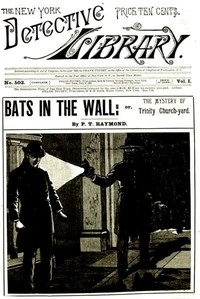
Before opening Bats in the Wall; or, The Mystery of Trinity Church-yard — Edition Insights, the edition data offers a quick orientation: 56,347 words, 4 hr 5 min estimated reading time, and 6 detected text sections.
The text analysis averages about 16.1 words per sentence, while the detected sections provide another way to judge how the source is divided.
Project Gutenberg metadata also associates the work with “Detective and mystery stories,” connecting these edition facts with the source record’s subject description.
Explore this collection
These alternatives are selected using recorded categories and estimated reading time.
About 234 minutes
Wandering Heroes Classic Adventures
53,642 recorded words. 11 minutes difference from this book's estimate.
View Gutenberg source #44574About 256 minutes
Wandering Heroes Classic Adventures
58,863 recorded words. 11 minutes difference from this book's estimate.
View Gutenberg source #53320About 263 minutes
Wandering Heroes Classic Adventures
60,410 recorded words. 18 minutes difference from this book's estimate.
View Gutenberg source #41366Search stored excerpts and compare books → Choose by your preferences →
Choices use stored catalog measurements. Estimates vary with reading speed. A shared category is a catalog label, not a claim that two books have the same argument or literary quality.
Search reads excerpt text stored with this catalog and links to its associated Gutenberg record. The connection is stored in the site database; this tool does not recheck that every excerpt is word-for-word identical to that external record. Excerpt search does not cover every chapter and does not verify historical publication dates.
Catalog snapshot checked: 2026-09-26. Coverage: 97 public books, 97 available source excerpts.
Calculated from edition completeness, EPUB availability, text structure and catalogue metadata. Not a user rating.
Total of 100 points, scaled to a 2.5-5.0 range. Editions with an empty description or a missing EPUB file are not scored.
Public-domain source text
The source text is kept in the dedicated reader, separate from this catalogue record and its commentary.
The novel opens with a sharp verbal clash between Frank Mansfield and Elijah Callister, where Callister rejects Frank's marriage proposal with cutting precision: “I am inclined to think that I could do somewhat better than to bestow the hand of my only daughter upon a bank clerk at a beggarly salary of twelve hundred a year.” The dialogue immediately establishes class tension and moral accusation, as Callister cites Frank's “drinking, gambling and nightly carousals.” This direct, confrontational speech sets the tone for a story driven by accusation and hidden motives.
Raymond’s descriptive style leans heavily on atmospheric detail. In the storm scene at Three Oaks, the wind “sighing through those gloomy old oaks” and the avenue “more nearly resembling a rushing river” create a Gothic mood. The characters’ dialogue—Callister’s petulant “Pah! what a beast of a night!” and Tisdale’s gloomy self-reproach—reveals their inner turmoil through colloquial, period-appropriate language.
Raymond uses dialogue not merely to advance plot but to expose character flaws and histories. In the opening chapter, Callister’s rejection is laced with class condescension and moral judgment, while Frank’s responses are defensive but respectful. Later, in the storm scene, Tisdale’s guilt surfaces: “With poor Maria's blood upon my hands calling for vengeance—ain't that enough?” This confession, spoken in a moment of vulnerability, contrasts with Callister’s pragmatic dismissal: “You ought to have thought of that before you struck her.” The exchange reveals Tisdale as a haunted accomplice and Callister as a cold pragmatist. The dialogue is peppered with exclamations and interruptions, mimicking natural speech patterns of the era.
The setting is rendered with sensory detail that amplifies tension. The storm at Three Oaks is described through sound (“wind sighing”), sight (“rushing river”), and touch (the “vicious snap” of the umbrella). Raymond’s narrator occasionally addresses the reader directly, as in “Dim as is the light of the match, it is sufficient to show us the faces of these midnight visitors.” This technique creates a sense of shared observation. The church-yard wall, referenced in the title, becomes a locus of mystery—Frank’s escape occurs “somewhere in the neighborhood of the wall of Trinity church-yard,” a detail that ties the physical setting to the central enigma.
The title “Bats in the Wall” hints at both literal creatures and hidden threats. In the excerpt, the church-yard wall is associated with Frank’s mysterious escape, and the “bats” may symbolize the lurking criminals or secrets. The storm scene’s darkness and the “gloomy old oaks” reinforce a sense of concealed danger. Raymond uses animal imagery sparingly but effectively: Tisdale’s lack of courage is compared to “no more than a mouse,” and Callister’s impatience is likened to a “beast.” These choices ground the melodrama in a tangible, almost primal fear.
Raymond employs a third-person omniscient narrator who occasionally editorializes, as when Tisdale is called “the bank burglar.” The diction is colloquial and of its time: “the deuce,” “pegged out,” “Satan's own time.” This language roots the story in the 1890s dime-novel tradition. The narrator also uses dramatic irony, revealing Tisdale’s guilt before the plot fully unfolds. The serialized origin is evident in chapter breaks that end on cliffhangers, such as Frank’s handcuffed escape. These authorial choices prioritize pace and suspense over psychological depth, fitting the genre’s expectations.
Readers attentive to Raymond’s craft will notice how he balances exposition with action, using dialogue to carry backstory and description to build mood. The novel rewards those who track the recurring imagery of walls, darkness, and confinement—both literal and metaphorical. Approach the text as a period artifact where every exclamation and stormy night serves to heighten the mystery.
I keep thinking about those bats—how they were never just décor but something uneasy, almost loyal, to the dark. It reminds me of reading Bats in the Wall again, then picking up an old edition of The Motor Boys in the Army; or, Ned, Bob and Jerry as Volunteers — Background and Themes, where the same sense of duty hums beneath the adventure, quiet as a held breath. Different storms, same hollowness after.
A brief reflection can help important ideas stay with you longer.