About 263 minutes
The Flying Boat: A Story of Adventure and Misadventure — A Closer Reading
Wandering Heroes Classic Adventures
60,410 recorded words. 7 minutes difference from this book's estimate.
View Gutenberg source #41366
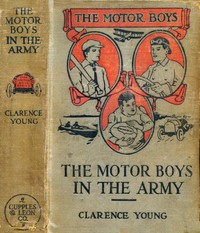
For The Motor Boys in the Army; or, Ned, Bob and Jerry as Volunteers — Background and Themes, the stored edition analysis reports 58,863 words, 4 hr 16 min estimated reading time, and 31 detected text sections.
The text analysis averages about 14.2 words per sentence, while the detected sections provide another way to judge how the source is divided.
Project Gutenberg metadata also associates the work with “Adventure stories,” connecting these edition facts with the source record’s subject description.
Explore this collection
These alternatives are selected using recorded categories and estimated reading time.
About 263 minutes
Wandering Heroes Classic Adventures
60,410 recorded words. 7 minutes difference from this book's estimate.
View Gutenberg source #41366About 245 minutes
Wandering Heroes Classic Adventures
56,347 recorded words. 11 minutes difference from this book's estimate.
View Gutenberg source #45492About 275 minutes
Wandering Heroes Classic Adventures
63,222 recorded words. 19 minutes difference from this book's estimate.
View Gutenberg source #40574Search stored excerpts and compare books → Choose by your preferences →
Choices use stored catalog measurements. Estimates vary with reading speed. A shared category is a catalog label, not a claim that two books have the same argument or literary quality.
Search reads excerpt text stored with this catalog and links to its associated Gutenberg record. The connection is stored in the site database; this tool does not recheck that every excerpt is word-for-word identical to that external record. Excerpt search does not cover every chapter and does not verify historical publication dates.
Catalog snapshot checked: 2026-09-26. Coverage: 97 public books, 97 available source excerpts.
Calculated from edition completeness, EPUB availability, text structure and catalogue metadata. Not a user rating.
Total of 100 points, scaled to a 2.5-5.0 range. Editions with an empty description or a missing EPUB file are not scored.
Public-domain source text
The source text is kept in the dedicated reader, separate from this catalogue record and its commentary.
Clarence Young opens The Motor Boys in the Army with a burst of colloquial dialogue that immediately establishes the trio's camaraderie and excitement. Ned Slade's exclamation, "Surest thing you know!" and Jerry Hopkins's reference to the last big excitement—"the old lumberyard burned"—ground the story in a small-town setting where local fires are the benchmark of drama. The author's choice to link arms while walking reinforces the boys' unity, a physical detail that recurs throughout the narrative.
Young distinguishes the three friends through their speech patterns. Ned favors emphatic phrases like "whoop up in great shape," while Bob's responses are more measured: "It ought to be quite a meeting, I should say." Jerry often acts as the observer, using phrases like "You said something!" to affirm. This verbal differentiation is consistent; later, when Bob accidentally spills coffee, his apology is apologetic and repetitive: "I didn't mean to… It was an accident." In contrast, Pug Kennedy's dialogue is aggressive and clipped: "Put ’em up, I say, or I’ll smash you in a minute!" The author uses these patterns to telegraph personality without explicit description.
Young interrupts the narrative with a lengthy explanation of army ranks, from private to commissioned officer. This passage, which details the V-shaped stripes of a corporal and the difference between non-commissioned and commissioned officers, serves an educational purpose typical of the series. The author's diction is precise: "The first step upward from private… is to be made a corporal." The digression is framed as natural conversation—Ned's ambition to become a corporal prompts Jerry's question, and the explanation follows. This technique balances plot momentum with informational asides, a hallmark of early twentieth-century juvenile fiction.
A spilled cup of coffee in the mess hall triggers a confrontation between Bob and Pug Kennedy. Young describes the incident with sensory detail: "Pug squirmed and twisted, trying to wipe some of the coffee stains from the back of his coat." The accident is accidental—"some one jostled me"—but Pug interprets it as deliberate. The author uses this minor mishap to escalate tension, with Jerry predicting "trouble with that fellow." The scene also showcases Captain Trainer's intervention, a deus ex machina that momentarily defuses the situation. Young's reliance on such everyday mishaps to drive conflict is a recurring structural choice.
The opening chapter establishes Cresville as a quiet town where a fire alarm constitutes major excitement. Young conveys setting through character speech rather than exposition: "There hasn’t been so much excitement in Cresville since I can remember." The mess hall scene later provides a contrasting interior—a "big room" where enlisted men eat under the watchful eye of officers. The author notes that "an officer… is a sort of damper at times," a wry observation that humanizes the military environment. These details, woven into dialogue and action, create a sense of place without lengthy descriptive passages.
Readers attentive to Young's authorial choices will notice how he uses dialogue to advance plot and reveal character, often at the expense of descriptive prose. The frequent digressions into military terminology reflect the series' educational intent, while the reliance on accidental spills and misunderstandings as plot devices gives the story a predictable rhythm. This edition invites scrutiny of how early twentieth-century adventure fiction balanced entertainment with instruction, and how the Motor Boys' adventures fit into that tradition.
That rainy afternoon, I kept thinking about how Clarence Young’s boys fumbled through military life—spilled coffee, misplaced orders—while their ranks stacked ever higher. It made me crave a quieter salt-water tale, and somehow I landed beside The Green Hand: Adventures of a Naval Lieutenant — A Reader’s Guide, where the sea swallows such small mistakes whole. A gentler kind of stumbling, that was.
Your answers remain private and are stored only in this browser.