About 291 minutes
The Salving of the "Fusi Yama": A Post-War Story of the Sea — Reading Notes
Wandering Heroes Classic Adventures
66,707 recorded words. 4 minutes difference from this book's estimate.
View Gutenberg source #52340
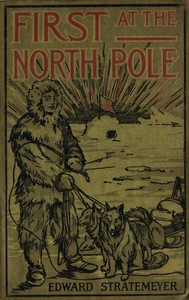
The catalog record for First at the North Pole; Or, Two Boys in the Arctic Circle — Themes and Context provides practical reading context through 67,641 words, 4 hr 55 min estimated reading time, and 7 detected text sections.
The text analysis averages about 13.5 words per sentence, while the detected sections provide another way to judge how the source is divided.
Project Gutenberg metadata also associates the work with “Adventure stories,” connecting these edition facts with the source record’s subject description.
Explore this collection
These alternatives are selected using recorded categories and estimated reading time.
About 291 minutes
Wandering Heroes Classic Adventures
66,707 recorded words. 4 minutes difference from this book's estimate.
View Gutenberg source #52340About 275 minutes
Wandering Heroes Classic Adventures
63,222 recorded words. 20 minutes difference from this book's estimate.
View Gutenberg source #40574About 319 minutes
Wandering Heroes Classic Adventures
73,279 recorded words. 24 minutes difference from this book's estimate.
View Gutenberg source #46795Search stored excerpts and compare books → Choose by your preferences →
Choices use stored catalog measurements. Estimates vary with reading speed. A shared category is a catalog label, not a claim that two books have the same argument or literary quality.
Search reads excerpt text stored with this catalog and links to its associated Gutenberg record. The connection is stored in the site database; this tool does not recheck that every excerpt is word-for-word identical to that external record. Excerpt search does not cover every chapter and does not verify historical publication dates.
Catalog snapshot checked: 2026-09-26. Coverage: 97 public books, 97 available source excerpts.
Calculated from edition completeness, EPUB availability, text structure and catalogue metadata. Not a user rating.
Total of 100 points, scaled to a 2.5-5.0 range. Editions with an empty description or a missing EPUB file are not scored.
Public-domain source text
The source text is kept in the dedicated reader, separate from this catalogue record and its commentary.
Edward Stratemeyer's First at the North Pole; Or, Two Boys in the Arctic Circle (1909) opens not on the ice but in a New England lumber camp, where Andy and Chet play a trick on Andy's shiftless relative Josiah Graham. The catalog subjects—Arctic exploration and the North Pole—suggest a straightforward polar adventure, yet the early chapters devote considerable space to the boys' domestic schemes and their recruitment by Barwell Dawson. The expedition itself does not begin until Chapter XVII, nearly a third of the way through the book.
The excerpt from Chapter I shows Andy and Chet tricking Josiah Graham into boarding a train, leaving him locked out of his own cabin. The dialogue is brisk and colloquial: “No—I got my hands full with Andy. Here is my train, so I can’t talk to yer no longer.” The boys' laughter afterward—“I thought I’d split, listening to the talk!”—reveals a tone closer to lighthearted mischief than Arctic gravitas. This episode, unrelated to polar exploration, occupies a full chapter and establishes the boys as resourceful pranksters rather than intrepid explorers. The catalog subject “Adventure stories” fits, but the specific flavor is boyish adventure in a domestic setting, not wilderness survival.
When the expedition finally launches, the narrative shifts to the steamer Ice King. The crew includes Dr. John Slade, “a quiet but friendly gentleman, who had once spent two years in lower Greenland,” and Mr. Samuel Camdal, “an old hunter, who had shot with Barwell Dawson in the far West and in Africa.” These characters are introduced with brief, functional descriptions. The boys' main concern is seasickness and arranging their stateroom, which “had a homelike air about it.” The catalog subject “Arctic regions -- Discovery and exploration” is present, but the text emphasizes the social dynamics of the party and the novelty of shipboard life rather than scientific or exploratory goals. Chet's personal quest—inquiries about the missing whaler Betsey Andrews and his father—adds a private motive not captured by the catalog subjects.
Chet's hope to “hear something about the missing whaler and his father” is mentioned twice in the excerpts, first in Chapter XVII and again in a conversation with Barwell Dawson about stopping at Upernivik. Dawson cautions, “But don’t be too sanguine. You may not hear a word of the whaler.” This personal subplot—a boy searching for a lost parent—is absent from the catalog subjects, which list only generic “Adventure stories” and “Arctic regions -- Discovery and exploration.” The excerpts do not reveal whether this quest is resolved, but its presence suggests a sentimental layer beneath the adventure surface. The catalog's focus on polar achievement overlooks this emotional driver, which may shape Chet's motivations more than the ambition to reach the North Pole.
Readers expecting a continuous polar narrative will find instead a book that delays the Arctic setting for nearly a third of its length, prioritizing character introduction and comic episodes. The catalog subjects accurately signal adventure and exploration, but the excerpts show a work equally invested in boyish humor and personal quests. Pay attention to how Stratemeyer balances these elements—the shift from domestic trickery to icebound peril is gradual, and the personal stakes may color the expedition's outcome more than the catalog suggests.
I remember how Andy and Chet’s laughter carried over that frozen deck, a warmth against the ice. It reminded me of another quiet crew, the travelers in The four Corners abroad — A Closer Reading, whose mischief never left their hearts either. Both books hold boys who chase wonders but really keep each other company.
Create a short personal record of your experience with this book.