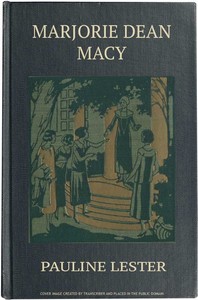
Marjorie Dean Macy — Inside the Classic

(0 User reviews)   246
Chase, Josephine, -1931 Project Gutenberg 2016 Not confirmed
Betrothal -- Juvenile fiction; Young women -- Social life and customs -- Juvenile fiction; Marriage customs and rites -- Juvenile fiction Readers of public-domain and historical texts
Project Gutenberg digital edition en

Edition facts

Words 60,378
Reading time 263 min
Text sections 26

This digital edition of Marjorie Dean Macy — Inside the Classic is described by source-level measurements including 60,378 words, 4 hr 23 min estimated reading time, and 26 detected text sections.

The text analysis averages about 14.2 words per sentence, while the detected sections provide another way to judge how the source is divided.

Project Gutenberg metadata also associates the work with “Betrothal -- Juvenile fiction,” connecting these edition facts with the source record’s subject description.

This editorial note examines how Marjorie Dean Macy uses setting transitions and recurring images—like the fountain and the love knot—to structure its narrative, focusing on the movement between California ranch life and the return to Wayland Hall.
Share
Editorial Edition Score 4.8/5

Calculated from edition completeness, EPUB availability, text structure and catalogue metadata. Not a user rating.

How this score is calculated
  • Description quality20 pts
  • Title & short description10 pts
  • Source metadata20 pts
  • Text length15 pts
  • Chapters / structure15 pts
  • EPUB file integrity20 pts

Total of 100 points, scaled to a 2.5-5.0 range. Editions with an empty description or a missing EPUB file are not scored.

Edition quality

Read the Text

“Here I am—all booted and spurred and ready to ride,” Marjorie Dean called out gaily to Veronica Lynne as Ronny entered the cool spacious patio of Lucero de la Manaña, the Lynnes’ beautiful ranch home in southern California.

Marjorie was a feast for beauty-loving eyes as she sat on the wide stone edge of the silver-spraying fountain with its musical murmur of water splashing into a white marble basin. The mannish cut of her gray knickered riding clothes merely made her look more than ever like a little girl. From under her little round gray hat with its bit of irridescent color her bright brown curls showed in a soft fluff. She sat smiling at Ronny, a sleeve of her riding coat pushed back from one rounded arm, one hand trailing idly in the clear water of the basin.

“You _sound_ like Paul Revere. At least, that is what he said, supposedly, on the night of his famous ride. You _look_ like Leila Harper’s friend, Beauty, even in riding togs.” Ronny came over to Marjorie, smiling.

“I only remember Leila Harper.” Marjorie glanced up teasingly.

“You are altogether too forgetful,” Ronny lightly reproved.

She paused, looking amusedly down at her pretty chum. She was wearing a white linen, knickered riding suit which was vastly becoming. Her wide gray eyes gave out a happy light that her heart switched on every time her gaze came to rest upon Marjorie.

Since first she had known Marjorie Dean, back in their senior high school days at Sanford, she had cherished a pet dream. That dream had come true six weeks previous when Marjorie, her father and mother had arrived from the East to make Ronny a long deferred visit. To range the great ranch, pony-back, with Marjorie riding beside her, ever a gracious, inspiriting comrade, was Ronny’s highest desire toward happiness.

“How long have you been waiting for me, Miss Paul Revere?” she playfully questioned. “Why didn’t you come to Ronny’s room and hang around? Why so unsociable?” Ronny drew down her face into an aggrieved expression which her dancing eyes contradicted. “I’ve known you to be much more cordial at old Wayland Hall.”

“Oh, I’ve only been here about three minutes. I’m miles more sociable than I was at Wayland Hall,” laughed Marjorie. “I thought you’d be ready and ahead of me. When I found you weren’t, I couldn’t resist stopping to dabble my hand in the water. I love the patio, Ronny, and adore the fountain. If I lived here three months longer I should be so steeped in the beauty of Manaña that I’d forget the East—maybe.” Her “maybe” was stronger than her light prediction.

“The magic spell of Manaña is upon you,” Ronny confidently asserted. “There is a mystical, romantic beauty about Manaña. I have searched for it over and over again in the East, but have never found it. It seems to me our Manaña is Nature’s own ideal of grandeur and beauty. I think the Spanish influence in the house and about the ranch heightens its claim to the romantic. Hamilton Arms has a certain stateliness of beauty, all its own. But has it anything more romantically beautiful than this patio?”

“It’s true as you live, Ronny Lynne,” agreed Marjorie gaily.

“You couldn’t love the patio better than I do.” Ronny cast a fond glance about the great square-covered court with its central crystal-spraying fountain and its ancient stone floor, gay with rugs and colorful Navajo blankets. The few inviting lounging chairs, the reading stand piled with current magazines, the quaint leather-covered Spanish couch, long and narrow, and heaped with gorgeous-hued silken cushions seemed only to accentuate the primitive charm of the old-time inclosure. Above it a railed-in Spanish balcony extended around the four sides. It was bright with flowering plants and further beautified by the masses of trailing vines which clambered over the old-time mahogany railing.

“I know it.” Marjorie gave a quick nod. “I’d not wish to love it as much as Hamilton Arms. I never thought I could care more for the Arms than dear Castle Dean. But I do. My whole heart is bound up in it, and Hamilton. I hope that I—that—we—will—” Marjorie stopped, her color deepening. “I hope Hal and I will live at Hamilton some day.” She continued in shy haste to finish what she had begun to say when girlish embarrassment had overtaken her.

The opening scene of Marjorie Dean Macy places the reader in a specific, sensory-rich setting: the patio of Lucero de la Manaña, where Marjorie sits by a fountain, one hand trailing in the water. This image of poised stillness contrasts with the energetic dialogue that follows, establishing a pattern of movement between repose and action that recurs throughout the excerpts. The narrative shifts from the California ranch to the familiar interior of Wayland Hall, using physical travel as a structural device to bridge episodes of friendship and reconciliation.

Fountains and Farewells: Recurring Images

The fountain in the opening patio is more than decoration; it reappears as a motif of pause and reflection. When Marjorie sits by the fountain, her trailing hand suggests a moment of idle waiting, yet the scene quickly propels into dialogue about riding and plans. Later, at Wayland Hall, the narrative lacks a fountain but substitutes other focal points—like the circle of friends gathered around Miss Remson—where water imagery is replaced by the emotional flow of conversation. The love knot of friends surrounding Marjorie as she opens packages (page 161) echoes the circular arrangement of the fountain, reinforcing a visual pattern of unity and containment.

Movement Between Two Worlds

The story moves decisively from the open, sunlit spaces of the California ranch to the enclosed, domestic setting of Wayland Hall. This transition is not merely geographic; it signals a shift in social dynamics. At the ranch, Marjorie and Ronny ride freely, their dialogue light and teasing. In the Hall, the conversation becomes more layered, dealing with past grievances and future arrangements. The excerpt shows the characters physically gathering in a circle, a formation that contrasts with the linear motion of horseback riding. The narrative uses these contrasting spaces to explore how relationships adapt when the setting changes from leisure to institutional life.

The Structure of Reconciliation Scenes

A key structural pattern in the excerpts is the carefully orchestrated reconciliation. The scene where Leslie is offered Room 15 unfolds in stages: Miss Remson’s deliberate pause, Leila’s significant glance, Marjorie’s flash of understanding, and finally the group’s supportive cheer. The narrative builds tension through small gestures—a hand raised arrestingly, a tear controlled—before releasing it in a handshake. This sequence mirrors the earlier fountain scene’s rhythm of stillness followed by action. The author uses the physical space of the room and the arrangement of characters to emphasize the communal nature of forgiveness, with each friend adding a plea before Marjorie’s simple request closes the matter.

Dialogue as a Vehicle for Character

The dialogue in these excerpts reveals character through speech patterns and word choice. Ronny’s playful reference to Paul Revere and her use of “hang around” establish her as informal and affectionate. Leila’s brogue-laden invitation—“it is myself that will be moving my trunks”—marks her as both theatrical and warm. Marjorie’s speech is direct and often teasing, as when she says she remembers only Leila Harper. The author uses these verbal tics to differentiate the friends without lengthy description. Even Miss Remson’s repeated “Now, now, now!” and her habit of making “odd little pauses” convey her managerial yet kind nature.

Readers may find it useful to track how the author signals emotional shifts through physical movement—from sitting to standing, from the fountain to the circle. The excerpts suggest that Marjorie Dean Macy builds its narrative less on plot events than on the careful arrangement of characters in space and the rhythm of their conversations. Pay attention to how scenes begin with a static image and then dissolve into dialogue, a technique that gives the story a measured, almost theatrical quality.

Re-reading the quiet way Marjorie Dean Macy lingers on the fountain’s return made me remember the stubborn repetition in Bouvard and Pécuchet: A Tragi-comic Novel of Bourgeois Life, part 2 — A Reader’s Guide—how certain objects anchor our restless attempts at meaning. Both leave a gentle ache, the sense of circling home without ever quite arriving. I found myself smiling at that shared, tender futility.

There are no reviews for this eBook.

0
0 out of 5 (0 User reviews )

Add a Review

Your Rating *
There are no comments for this eBook.

Reader reflection

Your personal reading reflection

Build a private reading journal entry for this title.

Your progress 0 / 10
1

What is your current status with this title?

2

How much did you enjoy the reading experience?

3

Would you pass this book on to a friend?

4

How easy was the book to follow?

Related eBooks