About 732 minutes
The Decameron (Day 6 to Day 10) Containing an hundred pleasant Novels — Reading Notes
Science Fiction Utopias
168,146 recorded words. 7 minutes difference from this book's estimate.
View Gutenberg source #52618
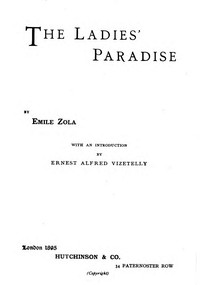
The Ladies' Paradise — A Reader’s Guide can be approached with a clearer sense of reading commitment from its source measurements: 169,764 words, 12 hr 19 min estimated reading time, and 14 detected text sections.
The text analysis averages about 19.3 words per sentence, while the detected sections provide another way to judge how the source is divided.
Project Gutenberg metadata also associates the work with “Paris (France) -- Fiction,” connecting these edition facts with the source record’s subject description.
Explore this collection
These alternatives are selected using recorded categories and estimated reading time.
About 732 minutes
Science Fiction Utopias
168,146 recorded words. 7 minutes difference from this book's estimate.
View Gutenberg source #52618About 716 minutes
Science Fiction Utopias
164,645 recorded words. 23 minutes difference from this book's estimate.
View Gutenberg source #54687About 540 minutes
Science Fiction Utopias
124,059 recorded words. 199 minutes difference from this book's estimate.
View Gutenberg source #40913Search stored excerpts and compare books → Choose by your preferences →
Choices use stored catalog measurements. Estimates vary with reading speed. A shared category is a catalog label, not a claim that two books have the same argument or literary quality.
Search reads excerpt text stored with this catalog and links to its associated Gutenberg record. The connection is stored in the site database; this tool does not recheck that every excerpt is word-for-word identical to that external record. Excerpt search does not cover every chapter and does not verify historical publication dates.
Catalog snapshot checked: 2026-09-26. Coverage: 97 public books, 97 available source excerpts.
Calculated from edition completeness, EPUB availability, text structure and catalogue metadata. Not a user rating.
Total of 100 points, scaled to a 2.5-5.0 range. Editions with an empty description or a missing EPUB file are not scored.
Public-domain source text
The source text is kept in the dedicated reader, separate from this catalogue record and its commentary.
Zola's The Ladies' Paradise opens with a simple greeting—'Ah, it's you, mademoiselle!'—that immediately establishes the conversational tone of the novel's dialogue. Yet this apparent simplicity belies a complex authorial strategy: the translator, Ernest Alfred Vizetelly, must navigate Zola's precise French to preserve the naturalism of speech while rendering it accessible to English readers. The novel's diction shifts between the clipped, urgent exchanges of shopgirls and the expansive, almost clinical descriptions of the department store's machinery. This editorial note examines three specific authorial choices visible in the excerpts: the use of physical detail to externalize inner states, the rhythm of dialogue as a marker of power, and the juxtaposition of intimate and commercial language.
In the scene between Denise and Geneviève, Zola uses the body as a site of emotional revelation. Geneviève's thinness is not merely described but demonstrated through action: 'She undid her dress, and was heart-rent on seeing how fearfully thin she had become. The poor girl's bosom was as hollow as a child's.' The narrator's eye lingers on the physical evidence of decline—the hollow bosom, the hair that 'seemed to be absorbing all her life'—making the body a text that speaks louder than words. This technique recurs throughout the excerpts: Geneviève's constant thirst, her trembling hand reaching for the water bottle, her refusal to let Denise help. Each gesture carries the weight of unspoken grief. Zola avoids direct psychological commentary; instead, he lets the body betray what the character tries to hide. The translator preserves this by choosing concrete verbs—'undid,' 'twisted,' 'cleared'—that keep the focus on physical action rather than abstract emotion.
The dialogue between Denise and Geneviève reveals a power struggle masked as solicitude. Geneviève's questions are sharp, probing: 'Tell me the truth: does he love her?' She interrupts Denise's evasions with 'Don't tell falsehoods, I beg of you.' The rhythm of the exchange—short, breathless lines from Geneviève versus longer, cautious replies from Denise—mirrors the imbalance of knowledge. Geneviève claims to 'feel it' and 'guess all,' yet she is desperate for confirmation. Zola's dialogue often operates on two levels: the surface meaning and the subtext of social or emotional negotiation. When Denise finally says 'But it's you he loves!' the lie is palpable, and Geneviève's response—'Very well, you won't tell me anything'—acknowledges the deception without confrontation. The translator captures this tension by preserving the colloquial contractions ('I'm,' 'don't') and the fragmented syntax of Geneviève's speech, which conveys her agitation.
Zola repeatedly juxtaposes the language of commerce with that of personal relationships. Geneviève's confession about her marriage expectations is framed in terms of habituation: 'I've been accustomed to the idea of this marriage for the last ten years.' She describes her love as a kind of transaction—'I must have ended by believing him to be my husband before he really was'—using the passive voice that echoes the depersonalization of the store. Even her physical decline is linked to the shop environment: 'one doesn't grow much in these shops,' her mother says. The novel's setting—a small draper's shop overshadowed by the vast department store—inflects every personal drama. The Baudu family's financial worries are inseparable from Geneviève's romantic despair. Zola's description of the shop as a place where people 'shut up here together, without any other distractions' suggests that the commercial space shapes emotional possibilities. The translator's choice of 'shut up' rather than 'confined' reinforces the sense of entrapment.
Ernest Alfred Vizetelly's translation, published in 1895, makes specific decisions that affect the reader's experience of Zola's prose. The excerpts show a preference for idiomatic English over literal fidelity: 'heart-rent' for a French phrase, 'good heavens!' for an exclamation. Vizetelly also adds explanatory touches, such as 'with an incredulous air' to clarify Geneviève's tone. These choices smooth the naturalistic roughness of Zola's original, which often uses repetition and awkward syntax to mimic speech. The translator's introduction frames the novel as a moral tale about collectivism, a lens that may color the reading. Readers should be aware that Vizetelly occasionally amplifies Zola's social commentary. The dialogue, however, retains its urgency: the short, staccato lines of Geneviève's speech—'I'm not stout, am I? I used to be stouter, but it's all gone away'—feel natural in English. The translation is a document of its time, reflecting Victorian sensibilities while striving to convey Zola's naturalism.
These observations are drawn solely from the excerpts provided; the complete novel may develop these patterns differently. Readers attentive to Zola's authorial choices will notice how he uses physical detail, dialogue rhythm, and the interplay of commercial and personal language to build a world where bodies and buildings alike bear the marks of economic forces. The translation by Vizetelly adds another layer of mediation, one that rewards scrutiny. Approach the text with an eye for the concrete: the gesture, the glance, the unfinished sentence.
Reading how Zola leaned on the weight of fabric and the press of crowds to carry emotion, I thought of a summer spent with The Young Circus Rider; or, the Mystery of Robert Rudd — Reading Companion, where the sawdust and lit ring held the same quiet ache of longing for a self beyond the tent.
Answer a few questions and save a private reflection on this device.