About 245 minutes
Larkspur — A Closer Reading
Fantasy Juvenile Worlds
56,331 recorded words. 5 minutes difference from this book's estimate.
View Gutenberg source #49098
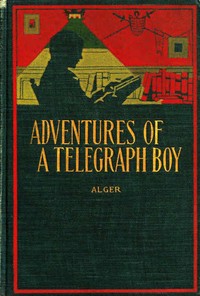
The catalog record for Adventures of a Telegraph Boy; or, "Number 91" — Themes and Context provides practical reading context through 55,065 words, 4 hr estimated reading time, and 44 detected text sections.
The text analysis averages about 11.5 words per sentence, while the detected sections provide another way to judge how the source is divided.
Project Gutenberg metadata also associates the work with “Orphans -- Juvenile fiction,” connecting these edition facts with the source record’s subject description.
Explore this collection
These alternatives are selected using recorded categories and estimated reading time.
About 245 minutes
Fantasy Juvenile Worlds
56,331 recorded words. 5 minutes difference from this book's estimate.
View Gutenberg source #49098About 247 minutes
Fantasy Juvenile Worlds
56,723 recorded words. 7 minutes difference from this book's estimate.
View Gutenberg source #39489About 247 minutes
Fantasy Juvenile Worlds
56,780 recorded words. 7 minutes difference from this book's estimate.
View Gutenberg source #41513Search stored excerpts and compare books → Choose by your preferences →
Choices use stored catalog measurements. Estimates vary with reading speed. A shared category is a catalog label, not a claim that two books have the same argument or literary quality.
Search reads excerpt text stored with this catalog and links to its associated Gutenberg record. The connection is stored in the site database; this tool does not recheck that every excerpt is word-for-word identical to that external record. Excerpt search does not cover every chapter and does not verify historical publication dates.
Catalog snapshot checked: 2026-09-26. Coverage: 97 public books, 97 available source excerpts.
Calculated from edition completeness, EPUB availability, text structure and catalogue metadata. Not a user rating.
Total of 100 points, scaled to a 2.5-5.0 range. Editions with an empty description or a missing EPUB file are not scored.
Public-domain source text
The source text is kept in the dedicated reader, separate from this catalogue record and its commentary.
The novel opens with a direct invitation to enter a telegraph office on Broadway, establishing an immediate sense of place. The narrator describes the boys on benches, their uniforms, and the numbered caps, singling out Number 91—Paul Parton—as the most attractive. This brisk, observational style gives way to longer stretches of dialogue, as seen in the extended exchange between Paul, Jennie Cunningham, and her cousin Mark Sterling. The shift from scene-setting to conversation marks a change in pace that recurs throughout the excerpts.
The opening chapter uses a second-person imperative—"Let us enter"—to draw the reader into the telegraph office. This technique is rare in the excerpts; after the first paragraph, the narrator retreats to a more conventional third-person voice. The initial description is notably efficient: the office layout, the railing, the superintendent's desk, and the boys' uniforms are all conveyed in a few sentences. The narrator singles out Paul by his number and appearance, using phrases like "warm, expressive face" and "most attractive in appearance" to signal his protagonist status without lengthy backstory. This economy of description contrasts with the later, more leisurely dialogue scenes.
The excerpt featuring Jennie, Mark, and Paul is almost entirely dialogue, with minimal narration. The conversation reveals character through tone and word choice: Mark's patronizing remarks—"for a telegraph boy" and "that class of—persons"—contrast with Paul's measured replies. Jennie's spirited defense of Paul, including her claim that "Paul is a nice boy," drives the scene. The narrator occasionally interjects with observations like "He quite understood that Mark meant to sneer at him" or "I am afraid he was really jealous of Paul," but these are brief. The pacing slows considerably here, as the dialogue unfolds in real time, allowing social dynamics to take center stage over plot advancement.
The excerpts show two distinct narrative modes: the brisk, scene-setting mode of the opening and the slower, dialogue-heavy mode of the social encounter. In the opening, the narrator moves quickly from the office to the boys to Paul, covering a lot of ground in few words. In the later scene, the narrator steps back, letting characters speak at length. This shift in narrative distance—from close observation to near-transcription of speech—alters the reading pace. The narrator's occasional interjections ("This rather took Mark by surprise") serve as brief pauses. The effect is a rhythm that alternates between efficient exposition and immersive conversation, a pattern likely sustained throughout the novel.
Readers may find it useful to note how Alger balances action and dialogue. The telegraph boy's job promises episodic adventures, but the excerpts suggest that social encounters—particularly those involving class and honor—receive equal weight. Pay attention to how the narrator's presence fades during conversations, allowing characters to define themselves through speech.
There's a certain fellow-feeling between that telegraph boy, racing through New York’s clamor, and the quiet voice in Azalea at Sunset Gap — A Closer Reading. Both understand that the real story happens in the pauses—between one errand and the next, in the slow hush of a mountain evening. I’ve always treasured that shared, unhurried heartbeat.
Answer a few questions and save a private reflection on this device.