About 247 minutes
With Beatty off Jutland: A Romance of the Great Sea Fight — Text and Context
Fantasy Juvenile Worlds
56,723 recorded words. 0 minutes difference from this book's estimate.
View Gutenberg source #39489
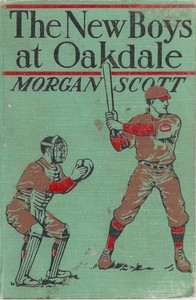
Before opening The New Boys at Oakdale — Reading Companion, the edition data offers a quick orientation: 56,780 words, 4 hr 7 min estimated reading time, and 6 detected text sections.
The text analysis averages about 15.3 words per sentence, while the detected sections provide another way to judge how the source is divided.
Project Gutenberg metadata also associates the work with “Schools -- Juvenile fiction,” connecting these edition facts with the source record’s subject description.
Explore this collection
These alternatives are selected using recorded categories and estimated reading time.
About 247 minutes
Fantasy Juvenile Worlds
56,723 recorded words. 0 minutes difference from this book's estimate.
View Gutenberg source #39489About 249 minutes
Fantasy Juvenile Worlds
57,262 recorded words. 2 minutes difference from this book's estimate.
View Gutenberg source #45802About 245 minutes
Fantasy Juvenile Worlds
56,331 recorded words. 2 minutes difference from this book's estimate.
View Gutenberg source #49098Search stored excerpts and compare books → Choose by your preferences →
Choices use stored catalog measurements. Estimates vary with reading speed. A shared category is a catalog label, not a claim that two books have the same argument or literary quality.
Search reads excerpt text stored with this catalog and links to its associated Gutenberg record. The connection is stored in the site database; this tool does not recheck that every excerpt is word-for-word identical to that external record. Excerpt search does not cover every chapter and does not verify historical publication dates.
Catalog snapshot checked: 2026-09-26. Coverage: 97 public books, 97 available source excerpts.
Calculated from edition completeness, EPUB availability, text structure and catalogue metadata. Not a user rating.
Total of 100 points, scaled to a 2.5-5.0 range. Editions with an empty description or a missing EPUB file are not scored.
Public-domain source text
The source text is kept in the dedicated reader, separate from this catalogue record and its commentary.
The opening chapter of The New Boys at Oakdale drops readers directly into a baseball game, with Oakdale hammering Wyndham's pitcher for three runs in the first inning. The prose is brisk, focused on plays and errors: Ned Osgood's costly blunder at third base, Charley Shultz's one-handed muff, and Captain Jack Nelson's sharp reprimand. This immediate immersion in sports action establishes a tone of competitive tension and team dynamics.
Yet the game is not merely athletic. The narrator notes that with perfect support, Oakdale's pitcher Rodney Grant would have shut out the locals. The errors are not just mistakes; they hint at character flaws—showboating, carelessness—that will echo later. The chapter title, “An Order Disobeyed,” suggests that disobedience, not just poor play, is at the story's core.
The transition from the opening baseball game to the middle excerpt's schoolroom scene is abrupt but revealing. The game's errors—Osgood's fancy play, Shultz's grandstanding—foreshadow the moral lapses that Professor Richardson addresses. The principal's speech about gambling and the injured Roy Hooker shifts the focus from athletic competition to ethical crisis. The narrator notes that students find it “most difficult to meet his look and appear interested without betraying guilt.” This interior tension, absent in the sports action, now dominates.
The professor's language is moralistic: gambling is a “contagious disease,” and the only cure is “good resolutions” and “will-power.” The scene is heavy with suspense—how much does Hooker remember? Who was involved? The reader, like the students, is left guessing. This section deepens the stakes beyond a game, suggesting that the real contest is between honesty and concealment.
Throughout the excerpts, certain words carry disproportionate weight. In the opening, Nelson tells Shultz, “Quit your grandstanding and play baseball.” That phrase—grandstanding—recurs in the middle excerpt when Osgood warns Piper not to “push the thing too hard” or Shultz may “balk.” The baseball term balk is repurposed for a moral context: a sudden refusal to cooperate, a breakdown under pressure.
Similarly, the professor's phrase “evil influences and bad associates” echoes the earlier team dynamics. The baseball errors were public; the gambling and injury are secret. The vocabulary of the game—errors, muffs, double plays—becomes a metaphor for social and ethical missteps. A first-time reader attuned to these verbal echoes will sense that the story's unity lies not in plot alone but in a consistent moral vocabulary drawn from the baseball field.
The excerpts provide only fragments of the full narrative. The opening game ends with Oakdale leading, but the outcome is not given. The middle scene leaves Hooker's condition uncertain—the professor says he “would fully recover,” but the students' fear suggests more at stake. The later excerpt is a Project Gutenberg boilerplate, not story text. Thus, the reader cannot know who injured Hooker, whether the guilty confess, or how the baseball season concludes.
This incompleteness is not a flaw but a feature for a first reading. The gaps invite speculation. The title The New Boys at Oakdale suggests that newcomers—perhaps Osgood or Piper—are central, but the excerpts do not identify them. The reader must attend to who is “new” and how they disrupt existing loyalties. The editorial note cannot resolve these mysteries; it can only point to where they lurk.
The novel's chapter titles, listed in the contents, reveal a deliberate arc: from “An Order Disobeyed” through “The Lie,” “Dread,” “Flight,” to “Like a Miracle” and “Comrades All.” This sequence promises a movement from transgression to revelation and reconciliation. The excerpts sample only the early and middle portions, but the titles alone suggest that the story builds toward a crisis—perhaps a confession or a rescue—before resolving in unity.
A first-time reader can use these titles as a map. The shift from baseball action (Chapters I–IV) to moral dilemmas (V–XII) to pursuit and discovery (XVI–XXVIII) indicates a genre blend: sports story, school story, and mystery. The excerpts confirm this blend: the opening is pure baseball, the middle is a moral lecture, and the later chapters (from titles) involve a search and a camp on an island. The reader should expect the pace to quicken and the setting to expand beyond the school grounds.
To read The New Boys at Oakdale attentively is to watch how a single baseball game's errors ripple into a school-wide crisis. The excerpts offer no easy answers—only a vivid opening, a tense middle, and a promise of resolution in the chapter titles. A first-time reader will benefit from noting how the language of sport shades into the language of conscience, and how the characters' public performances on the field contrast with their private guilt. The story's power lies not in its plot twists but in its consistent moral pressure, applied inning by inning.
I often think of Morgan Scott’s boys at Oakdale, the way their baseball diamond becomes a quiet stage for conscience, right when a moral crisis steals the field. It reminds me of another old friend, where fairyland’s glow hides trickier shadows. These two sit side by side on my shelf, each knowing that play—be it a game or a spell—is merely the doorway to growing up. The Brownies and Prince Florimel; Or, Brownieland, Fairyland, and Demonland — Edition Insights holds that same gentle secret.
Your answers remain private and are stored only in this browser.