About 178 minutes
Young Stowaways in Space — Context and Discussion
Wandering Heroes Classic Adventures
40,769 recorded words. 38 minutes difference from this book's estimate.
View Gutenberg source #54547
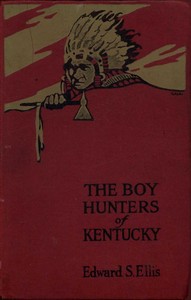
The catalog record for The Boy Hunters of Kentucky — A Reader’s Guide provides practical reading context through 32,083 words, 2 hr 20 min estimated reading time, and 5 detected text sections.
The text analysis averages about 22.2 words per sentence, while the detected sections provide another way to judge how the source is divided.
Project Gutenberg metadata also associates the work with “Hunting stories,” connecting these edition facts with the source record’s subject description.
Explore this collection
These alternatives are selected using recorded categories and estimated reading time.
About 178 minutes
Wandering Heroes Classic Adventures
40,769 recorded words. 38 minutes difference from this book's estimate.
View Gutenberg source #54547About 193 minutes
Wandering Heroes Classic Adventures
44,252 recorded words. 53 minutes difference from this book's estimate.
View Gutenberg source #39488About 208 minutes
Wandering Heroes Classic Adventures
47,747 recorded words. 68 minutes difference from this book's estimate.
View Gutenberg source #54915Search stored excerpts and compare books → Choose by your preferences →
Choices use stored catalog measurements. Estimates vary with reading speed. A shared category is a catalog label, not a claim that two books have the same argument or literary quality.
Search reads excerpt text stored with this catalog and links to its associated Gutenberg record. The connection is stored in the site database; this tool does not recheck that every excerpt is word-for-word identical to that external record. Excerpt search does not cover every chapter and does not verify historical publication dates.
Catalog snapshot checked: 2026-09-26. Coverage: 97 public books, 97 available source excerpts.
Calculated from edition completeness, EPUB availability, text structure and catalogue metadata. Not a user rating.
Total of 100 points, scaled to a 2.5-5.0 range. Editions with an empty description or a missing EPUB file are not scored.
Public-domain source text
The source text is kept in the dedicated reader, separate from this catalogue record and its commentary.
Edward S. Ellis opens The Boy Hunters of Kentucky with a direct address to the reader, establishing an instructional tone that persists throughout the narrative. The first chapter immediately grounds the story in historical context, noting that Kentucky was known as the 'Dark and Bloody Ground' due to conflicts between settlers and Native Americans. The author introduces twelve-year-old Jack Gedney on the morning of his birthday, when his father presents him with a rifle—a gift that signals the boy's transition into the responsibilities of frontier life.
Ellis's prose is brisk and declarative, favoring action over introspection. He frequently interjects with phrases like 'you must know' and 'you may have heard,' creating a conversational rapport with his young audience. The authorial voice is confident and paternal, guiding readers through the dangers and skills of the Kentucky wilderness.
Ellis repeatedly breaks the fourth wall to speak directly to his readers, a technique common in nineteenth-century juvenile fiction. In the opening chapter, he writes, 'Now, you must know that some of the best riflemen in the world have been born and reared in Kentucky,' immediately positioning the narrative as both entertainment and education. This didactic strain continues as he explains historical context—the influx of settlers, the construction of cabins from flatboats, and the ever-present threat of Indian attacks.
The author's voice is notably confident and paternal. He assumes authority over the material, often using phrases like 'It need not be said' or 'You cannot wonder that.' This rhetorical strategy keeps the reader engaged while subtly reinforcing the moral and practical lessons embedded in the story. Ellis does not simply tell a tale; he instructs his audience in the virtues of courage, resourcefulness, and marksmanship.
Ellis's word choice consistently emphasizes the precariousness of frontier life and the necessity of skill. Descriptions of encounters with bears are laced with urgency: the bear's 'long sharp nails rattled against one of Jack's shoes,' and the boys climb trees with 'desperate energy.' The author uses precise verbs—'flung,' 'travelling,' 'jerked'—to convey physical effort and narrow escapes.
The language of marksmanship is equally specific. Characters 'ramming a bullet into his rifle,' 'pouring the priming into the pan,' and 'drawing back the hammer' are described with technical accuracy. This attention to the mechanics of loading and firing a rifle reflects the author's intent to educate as well as entertain. The boys' success hinges on their ability to perform these actions under pressure, and Ellis rewards careful execution with survival.
The narrative is built around a repeating pattern of threat, flight, and counterattack. In the bear episode, Jack is treed first, then Will, and finally George must reload and fire while hidden. Ellis structures the scene to maximize tension: each boy's escape is described in sequence, with the bear's frustration mounting. The author uses short, punchy sentences to accelerate the pace: 'The bear found not one, but two boys.'
This structural repetition serves a dual purpose. It reinforces the dangers of the wilderness while demonstrating that survival depends on quick thinking and cooperation. The boys do not panic; they execute a plan. Ellis's reliance on this pattern—pursuit, narrow escape, decisive shot—gives the story a rhythmic, almost formulaic quality that would have been familiar and satisfying to his young readers.
Ellis populates his Kentucky landscape with specific, recurring details that ground the adventure in a recognizable frontier. Trees are not merely trees; they are 'saplings' and 'big oak trunks' that serve as refuges. The bear is consistently called 'Bruin,' a personification that adds a folkloric quality. The author notes the 'fertile soil' of natural clearings and the 'flat boat' that brought settlers down the Ohio River.
These details are not decorative; they are functional. The boys' ability to identify a suitable climbing tree or to use a trunk for cover is integral to their survival. Ellis also includes small, telling observations—the bear's 'stupid way' of looking up, the 'little sphere of lead' that kills it—that reveal his familiarity with hunting and woodcraft. The setting is not a backdrop but an active participant in the drama.
Readers attentive to Ellis's authorial choices will notice how the narrative balances instruction with excitement. The direct address, technical vocabulary, and patterned structure all serve to teach frontier skills while keeping the story moving. This edition preserves the original text's brisk pace and moral clarity, offering a window into the expectations of nineteenth-century juvenile adventure fiction.
Reading about Jack Gedney's first rifle reminded me of my grandfather's old powder horn, which I never touched but loved to look at. The same feeling came back years later with One of Clive's Heroes: A Story of the Fight for India — A Reader’s Guide, where a boy's courage feels just as heavy and quiet to me now.
Answer a few questions and save a private reflection on this device.