About 268 minutes
The Flying Reporter — Text and Context
Fantasy Juvenile Worlds
61,442 recorded words. 9 minutes difference from this book's estimate.
View Gutenberg source #44227
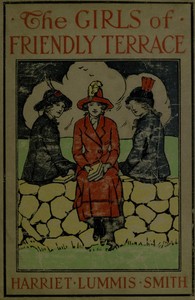
The catalog record for The Girls of Friendly Terrace; or, Peggy Raymond's Success — Story, Setting & Ideas provides practical reading context through 63,705 words, 4 hr 37 min estimated reading time, and 8 detected text sections.
The text analysis averages about 14.8 words per sentence, while the detected sections provide another way to judge how the source is divided.
Project Gutenberg metadata also associates the work with “Friendship -- Juvenile fiction,” connecting these edition facts with the source record’s subject description.
Explore this collection
These alternatives are selected using recorded categories and estimated reading time.
About 268 minutes
Fantasy Juvenile Worlds
61,442 recorded words. 9 minutes difference from this book's estimate.
View Gutenberg source #44227About 267 minutes
Fantasy Juvenile Worlds
61,278 recorded words. 10 minutes difference from this book's estimate.
View Gutenberg source #43141About 289 minutes
Fantasy Juvenile Worlds
66,255 recorded words. 12 minutes difference from this book's estimate.
View Gutenberg source #45974Search stored excerpts and compare books → Choose by your preferences →
Choices use stored catalog measurements. Estimates vary with reading speed. A shared category is a catalog label, not a claim that two books have the same argument or literary quality.
Search reads excerpt text stored with this catalog and links to its associated Gutenberg record. The connection is stored in the site database; this tool does not recheck that every excerpt is word-for-word identical to that external record. Excerpt search does not cover every chapter and does not verify historical publication dates.
Catalog snapshot checked: 2026-09-26. Coverage: 97 public books, 97 available source excerpts.
Calculated from edition completeness, EPUB availability, text structure and catalogue metadata. Not a user rating.
Total of 100 points, scaled to a 2.5-5.0 range. Editions with an empty description or a missing EPUB file are not scored.
Public-domain source text
The source text is kept in the dedicated reader, separate from this catalogue record and its commentary.
Harriet Lummis Smith opens The Girls of Friendly Terrace with a wry observation about the naming of the street: "The naming of the Terrace was a happy accident. It must have been an accident." This deliberate repetition and the contrast between the name and the initial absence of friendly activity establish a tone of gentle irony. The narrator quickly populates the scene with three girls—Priscilla, Amy, and Ruth—each described through physical traits and a telling detail: Priscilla is "mortally afraid of growing taller," while Amy is "in a chronic state of announcing her determination to leave off eating candy next week." These characterizations rely on specific, concrete language rather than abstract praise, grounding the story in observable behavior.
Smith's word choices reveal character with economy. Amy's reminiscence about her aunt's train being "six hours late" introduces a tendency toward exaggeration and self-dramatization. Ruth's reply—"O Peggy's train couldn't be late, she's coming such a tiny bit of a way"—uses the colloquial "O" and the diminutive "tiny bit" to convey both affection and a desire to reassure. The narrator describes Ruth as having "an alert air" that shows she is "on the watch for something or somebody," a phrase that blends physical description with psychological state. Later, when Peggy reacts to Dorothy's discovery of a doll's petticoat, the narrator notes that Peggy "stifled the irritable exclamation which rose to her lips with such unwonted readiness." The adverb "unwonted" signals a departure from Peggy's usual patience, hinting at internal conflict without explicit statement.
The dialogue in the excerpts encodes the social expectations of the girls' world. When Ruth confesses that Christmas is "just spoiled" because of her brother Graham's deceit, Peggy advises: "there is only one way out, and that's to be frank and above board." The idiomatic phrase "above board" belongs to a register of moral clarity that the novel endorses. The narrator then comments: "Unwelcome advice seldom seems good advice to the recipient." This aphoristic aside distances the narrative voice from Peggy's perspective, allowing the reader to judge Ruth's resistance. In contrast, Dorothy's speech is marked by childish logic: "It looks 'zactly like a dunce cap, Aunt Peggy, and then I'd be the little dunce, wouldn't I?" The misspelling in the transcription ("'zactly") and the tentative suggestion about the petticoat show Smith's ear for juvenile diction.
Gift-making and gift-receiving form a structural motif in the excerpts. Peggy's "bureau scarf" and Dorothy's shopping list—"'fumery," a "naughty-mobeel," and a "candy cane"—illustrate the economic and emotional stakes of Christmas preparations. The narrator notes that Dorothy "had not reached the point of estimating a gift by its money value," a statement that implicitly contrasts with adult concerns. Secrets also recur: Ruth reads a letter without permission, and Peggy hides her irritation. The narrator describes Peggy's "varying moods of dejection and irritation" as a "trifling cause for disquiet" compared to Ruth's burden, using the word "trifling" to minimize Peggy's complaints while acknowledging their reality. This layering of small disappointments—a lost petticoat, a brother's deceit—creates a texture of everyday moral complexity.
Smith's narrator shifts between close focalization and detached commentary. When Peggy "felt a little twinge of shame" for her earlier irritability, the narrator reports her thoughts indirectly: "The finishing of a specified number of gifts at a specified time seemed a trifling cause for disquiet." The repetition of "specified" mimics the mechanical nature of Peggy's task, while the word "trifling" echoes the narrator's earlier judgment of Ruth's reaction. Later, the narrator describes Peggy as having "less of the air of a sweat-shop worker" after she resolves to be patient—a simile that introduces a note of social critique into a domestic scene. The final sentence of the excerpt, describing Ruth's "bitterest of all disillusions, disappointment in one she had loved and trusted," uses parallel structure and elevated diction to elevate a juvenile problem to a universal theme.
Readers attentive to Smith's diction will notice how often she uses the word "little" to modify emotions and objects—"a tiny bit of a way," "a little twinge of shame," "a little dunce cap." This verbal tic suggests a world scaled to childhood, where even serious disappointments are contained by domestic boundaries. The novel rewards attention to such patterns, as they reveal the author's craft in balancing sentiment with realism.
This book reminds me of summer afternoons on my grandmother’s porch, where the girls’ careful negotiations over borrowed ribbons felt like quiet diplomacy. I once had that same warm ache reading The Flying Reporter — Text and Context, where a boy’s impulsive kindness also needed its own gentle limits. Funny how old stories still hold those tender boundaries.
Create a short personal record of your experience with this book.