About 331 minutes
The Wyndham Girls — Reading Notes
Fantasy Juvenile Worlds
75,970 recorded words. 2 minutes difference from this book's estimate.
View Gutenberg source #47739
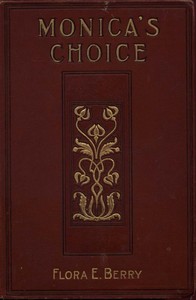
For Monica's choice — Story, Setting & Ideas, the stored edition analysis reports 76,378 words, 5 hr 33 min estimated reading time, and 11 detected text sections.
The text analysis averages about 20.5 words per sentence, while the detected sections provide another way to judge how the source is divided.
Project Gutenberg metadata also associates the work with “Christian life -- Juvenile fiction,” connecting these edition facts with the source record’s subject description.
Explore this collection
These alternatives are selected using recorded categories and estimated reading time.
About 331 minutes
Fantasy Juvenile Worlds
75,970 recorded words. 2 minutes difference from this book's estimate.
View Gutenberg source #47739About 358 minutes
Fantasy Juvenile Worlds
82,311 recorded words. 25 minutes difference from this book's estimate.
View Gutenberg source #41515About 298 minutes
Fantasy Juvenile Worlds
68,455 recorded words. 35 minutes difference from this book's estimate.
View Gutenberg source #42870Search stored excerpts and compare books → Choose by your preferences →
Choices use stored catalog measurements. Estimates vary with reading speed. A shared category is a catalog label, not a claim that two books have the same argument or literary quality.
Search reads excerpt text stored with this catalog and links to its associated Gutenberg record. The connection is stored in the site database; this tool does not recheck that every excerpt is word-for-word identical to that external record. Excerpt search does not cover every chapter and does not verify historical publication dates.
Catalog snapshot checked: 2026-09-26. Coverage: 97 public books, 97 available source excerpts.
Calculated from edition completeness, EPUB availability, text structure and catalogue metadata. Not a user rating.
Total of 100 points, scaled to a 2.5-5.0 range. Editions with an empty description or a missing EPUB file are not scored.
Public-domain source text
The source text is kept in the dedicated reader, separate from this catalogue record and its commentary.
The novel opens with a telling contrast: Mrs. Beauchamp, aristocratic and weary, sighs over her granddaughter Monica, while Monica herself enters “like a young lioness at bay.” The grandmother’s frustration—she wishes Conrad had never left the girl with her—immediately establishes a central tension between duty and resentment. Monica’s wilfulness is not merely described; it is shown through slammed doors that jingle the drawing-room knick-knacks, a small but precise detail linking her rebellion to the fragile order of the household.
Later, in a schoolroom scene, the focus shifts to a different kind of conflict. Olive witnesses Lily Howell cheating during an arithmetic exam, using notes hidden behind a pencil-box. Monica, who “loathed telling tales,” refuses to report it, but Olive threatens to expose Lily if she comes out top. The episode ends with Lily planting the crib notes in Monica’s desk, framing her. This sequence reveals how the story uses school dynamics to explore honor, deception, and the consequences of silence.
The title Monica’s Choice signals that the protagonist’s decisions are central, but the excerpts show that her choices are heavily constrained. She is an orphaned granddaughter left in the care of a grandmother who finds her a burden. Mrs. Beauchamp’s internal monologue—“I am sure I wish Conrad had never left her with me”—reveals a reluctant guardian, not a loving one. Monica’s response to being summoned is defiant: she slams the door, a physical assertion of will against the fragile, ornamented drawing-room that represents her grandmother’s world.
Yet Monica is also subject to the judgments of others. In the schoolroom, she is described as “tall, and with a haughty mien,” but her face “denoted much character.” This phrasing suggests a tension between how she appears and how she is perceived. The governesses, we learn, have failed to manage her, and her grandmother admits she doesn’t know what to do. Monica is thus positioned as a problem to be solved, not a person with agency—a setup that makes the promised “choice” all the more significant.
The arithmetic exam scene is the most detailed episode in the excerpts, and it operates as a microcosm of the novel’s moral landscape. Olive, Monica’s friend, spots Lily Howell using a hidden crib sheet. Olive’s reaction is visceral: she calls Lily a “horrid, mean, hateful sneak” and imagines her being expelled. But when the evidence vanishes, Olive is left frustrated, unable to prove what she saw. Monica’s response—“Oh, let it be”—shows a preference for avoiding confrontation, even when wronged.
Lily’s countermove is calculated: she drops the crib notes in Monica’s desk to frame her. The text notes that Lily acted “under the impression that her neat little scheme … had been quite unobserved.” This detail highlights the gap between appearance and reality that runs through the story. The cheating incident is not just a schoolyard drama; it tests friendships, exposes hypocrisy, and sets up a situation where Monica may have to defend her integrity against false evidence.
The excerpts rely heavily on dialogue and interior monologue to advance conflict. Mrs. Beauchamp’s thoughts are given in full, with her sighing and mechanical toying with rings conveying her anxiety. Monica’s speech is direct and confrontational: “Barnes told me that you had sent for me, grand-mamma.” The formal address contrasts with her aggressive entrance, suggesting a struggle between expected decorum and genuine emotion.
In the schoolroom, Olive’s internal outrage is rendered in exclamatory fragments: “The horrid, mean, hateful sneak!” This colloquial voice differs sharply from the narrator’s more measured descriptions, creating a layered effect. The chapter titles, drawn from quoted lines, further emphasize spoken language as a driver of plot. Titles like “I Wish Conrad Had Never Left Her with Me” and “A Nice Scrape She’ll Get Into!” preview key moments of tension, inviting readers to attend to what characters say—and what they leave unsaid.
Readers attentive to the novel’s patterns will notice how often characters are observed watching one another: Olive watches Lily, Monica watches Olive, and Mrs. Beauchamp watches Monica. This surveillance creates a world where actions are rarely private, and reputation is fragile. The cheating episode, in particular, rewards close attention to who sees what and when. As the story unfolds, Monica’s choices will likely involve navigating these layers of scrutiny—deciding when to speak, when to stay silent, and how to act when the truth is not easily proved.
Reading about Monica’s quiet defiance under her grandmother’s watch made me think of another kind of stubbornness I once stumbled upon. The Girls of Friendly Terrace; or, Peggy Raymond's Success — Story, Setting & Ideas carries that same gentle ache of growing up surrounded by expectations, where loyalties bend and choices feel heavier than they should at that age. It stayed with me like a half-remembered afternoon.
Create a short personal record of your experience with this book.