About 211 minutes
Billy Bounce — Key Ideas to Explore
Fantasy Juvenile Worlds
48,328 recorded words. 5 minutes difference from this book's estimate.
View Gutenberg source #48537
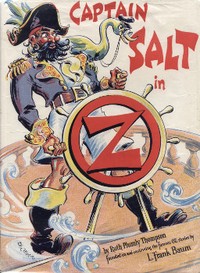
Captain Salt in Oz — Themes and Context can be approached with a clearer sense of reading commitment from its source measurements: 49,569 words, 3 hr 36 min estimated reading time, and 7 detected text sections.
The text analysis averages about 16.7 words per sentence, while the detected sections provide another way to judge how the source is divided.
Project Gutenberg metadata also associates the work with “Oz (Imaginary place) -- Juvenile fiction,” connecting these edition facts with the source record’s subject description.
Explore this collection
These alternatives are selected using recorded categories and estimated reading time.
About 211 minutes
Fantasy Juvenile Worlds
48,328 recorded words. 5 minutes difference from this book's estimate.
View Gutenberg source #48537About 210 minutes
Fantasy Juvenile Worlds
48,151 recorded words. 6 minutes difference from this book's estimate.
View Gutenberg source #49002About 208 minutes
Fantasy Juvenile Worlds
47,754 recorded words. 8 minutes difference from this book's estimate.
View Gutenberg source #55851Search stored excerpts and compare books → Choose by your preferences →
Choices use stored catalog measurements. Estimates vary with reading speed. A shared category is a catalog label, not a claim that two books have the same argument or literary quality.
Search reads excerpt text stored with this catalog and links to its associated Gutenberg record. The connection is stored in the site database; this tool does not recheck that every excerpt is word-for-word identical to that external record. Excerpt search does not cover every chapter and does not verify historical publication dates.
Catalog snapshot checked: 2026-09-26. Coverage: 97 public books, 97 available source excerpts.
Calculated from edition completeness, EPUB availability, text structure and catalogue metadata. Not a user rating.
Total of 100 points, scaled to a 2.5-5.0 range. Editions with an empty description or a missing EPUB file are not scored.
Public-domain source text
The source text is kept in the dedicated reader, separate from this catalogue record and its commentary.
Ruth Plumly Thompson's Captain Salt in Oz (1936) opens not in Oz but eight miles east of Pingaree, on the eight-sided Octagon Isle of King Ato the Eighth. The catalog subject 'Oz (Imaginary place)' is misleading: the story is a sea voyage through the Nonestic Ocean, with Oz mentioned only as the destination for newly discovered lands. The excerpts show a world of crystal peaks, sea forests, and roc's eggs, not the familiar Oz landmarks. Thompson's dedication and opening poem frame the book as a 'voyage' for 'discovering new countries for OZ,' making it more an expansion of Oz's geography than a tale set within it.
The catalog lists 'Oz (Imaginary place)' as the primary subject, but the excerpts reveal that Oz itself appears only as a distant goal. The opening chapter is set on Octagon Isle, and the ship Crescent Moon sails the Nonestic Ocean. Captain Samuel Salt's mission is to 'discover new countries for OZ,' not to explore Oz. The young protagonist Tandy is a former king who prefers being a sailor, and his journey is one of exploration, not of visiting Oz's familiar locations. The only Oz reference in the excerpts is the dedication's promise to add new lands to Oz's map. Readers expecting the Emerald City or the Scarecrow will find instead a nautical adventure with its own distinct geography.
Thompson's narrative emphasizes collecting and cataloging, not magic. Samuel Salt is a collector: he discusses a 'roc's egg' as a 'specimen' and has a 'tray of lamp shells.' The chapter titles include 'Samuel's First Specimen' and 'Strange Specimens for Samuel Salt.' This scientific curiosity contrasts with the catalog's 'Fantasy fiction' label, which might imply whimsical magic. Instead, the fantasy lies in the exotic settings—a crystal island with bridges, a sea forest—treated as natural wonders to be observed and collected. The tone is more akin to a naturalist's log than a fairy tale, with characters like Roger the Read Bird serving practical functions (reading aloud, fanning) rather than casting spells.
The excerpts describe a world independent of Oz's established map. Octagon Isle is 'eight-sided,' with a castle and a Read Bird. The crystal island features 'needle-like peaks' and 'a perfect maze of high and airy bridges' where 'Mountaineers' brandish 'glittering poles and spears.' This is not the Oz of the Emerald City or the Winkie Country. Thompson invents new realms—'Patrippany Island,' 'the City of Bridges,' 'the Sea Forest'—that owe nothing to L. Frank Baum's original settings. The catalog subject 'Adventure stories' fits well, as the narrative focuses on sea chases, storms, and encounters with hostile islanders. The geography is self-contained, making the book a standalone adventure rather than a direct sequel to earlier Oz books.
Readers approaching Captain Salt in Oz through its catalog subjects should set aside expectations of a traditional Oz story. Thompson delivers a sea adventure with its own rules, where collecting specimens and navigating strange islands take precedence over magic and familiar characters. The book rewards those who enjoy detailed world-building and episodic exploration, but it is best read as a nautical fantasy in the Oz-adjacent universe, not as a core Oz installment.
I found myself leafing through Captain Salt in Oz the other day, lingering on how quietly Tandy grows into his own confidence among those strange, empty seas. It’s less about Oz itself than about finding a footing in a brand-new place. That same hushed feeling of adjustment came back to me with The New Boys at Oakdale — Reading Companion, where belonging isn't handed over, just slowly, gently earned.
Build a private reading journal entry for this title.