About 211 minutes
Billy Bounce — Key Ideas to Explore
Fantasy Juvenile Worlds
48,328 recorded words. 1 minutes difference from this book's estimate.
View Gutenberg source #48537
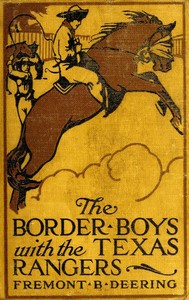
The catalog record for The Border Boys with the Texas Rangers — Context and Discussion provides practical reading context through 48,151 words, 3 hr 30 min estimated reading time, and 8 detected text sections.
The text analysis averages about 16.0 words per sentence, while the detected sections provide another way to judge how the source is divided.
Project Gutenberg metadata also associates the work with “Texas -- Juvenile fiction,” connecting these edition facts with the source record’s subject description.
Explore this collection
These alternatives are selected using recorded categories and estimated reading time.
About 211 minutes
Fantasy Juvenile Worlds
48,328 recorded words. 1 minutes difference from this book's estimate.
View Gutenberg source #48537About 208 minutes
Fantasy Juvenile Worlds
47,754 recorded words. 2 minutes difference from this book's estimate.
View Gutenberg source #55851About 216 minutes
Fantasy Juvenile Worlds
49,569 recorded words. 6 minutes difference from this book's estimate.
View Gutenberg source #56073Search stored excerpts and compare books → Choose by your preferences →
Choices use stored catalog measurements. Estimates vary with reading speed. A shared category is a catalog label, not a claim that two books have the same argument or literary quality.
Search reads excerpt text stored with this catalog and links to its associated Gutenberg record. The connection is stored in the site database; this tool does not recheck that every excerpt is word-for-word identical to that external record. Excerpt search does not cover every chapter and does not verify historical publication dates.
Catalog snapshot checked: 2026-09-26. Coverage: 97 public books, 97 available source excerpts.
Calculated from edition completeness, EPUB availability, text structure and catalogue metadata. Not a user rating.
Total of 100 points, scaled to a 2.5-5.0 range. Editions with an empty description or a missing EPUB file are not scored.
Public-domain source text
The source text is kept in the dedicated reader, separate from this catalogue record and its commentary.
The opening chapter of The Border Boys with the Texas Rangers establishes a pattern of sudden, sensory-driven movement. The narrative begins with a distant uproar—"Yip! Yip! Y–e–e–e–e–ow!"—and a cloud of yellow dust that "hung like a saffron curtain" before the riders appear. This technique of announcing action through sound and visual haze recurs throughout the excerpts, creating a rhythm of anticipation and delayed revelation. The story alternates between group scenes, such as the boys' initial encounter with the Rangers, and isolated sequences where a single character, like Jack Merrill, faces the landscape alone. This structural oscillation between camaraderie and solitude is a key feature of the work.
The excerpts repeatedly place characters in precarious vertical settings. Jack climbs a "dread precipice" to escape a valley, and the frontispiece caption describes him and his pony "rolling and plunging off the trail down toward the river." These moments of ascent and descent are not merely scenic; they structure the plot by separating characters and creating obstacles. The valley itself is described as a "Pool of Death," a sunken space that traps both Jack and the Mexican Alvarez. The narrative uses height to generate tension: the climb for life, the battle in mid-air, and the view from above that reveals an empty, rolling plain. This vertical emphasis gives the adventure a tangible, spatial urgency.
Goldfrap builds the Texas border setting through repeated sensory details. Dust appears as a "saffron curtain" and later as a "cloud of yellow dust" that obscures riders. The sun is a "red hot copper ball" in a "steely blue sky," and the ground is "hot" under a yucca. These elements are not static backdrops; they actively affect the characters. Jack feels weak from hunger and thirst, and the heat contributes to his despair. The sandstorm mentioned in the chapter list is another environmental threat. By grounding the action in physical discomfort—thirst, exhaustion, heat—the author makes the setting a participant in the story rather than mere decoration.
A notable structural device is the sequence of despair followed by self-recovery. When Jack finds himself alone on the plain, he gives way to hopelessness: "What is to become of me?" he cries, imagining his bones bleaching. But he then recalls his father's saying, "Never give up while you’ve a kick left in you," and scolds himself for "giving up like a girl or a baby." This internal rallying is a recurring beat in adventure fiction, but here it is tied specifically to the father's voice and the boy's sense of shame. The narrative does not allow Jack to remain passive; it forces him to move eastward, even without a clear reason. This pattern of collapse and renewed effort drives the solo sections of the plot.
The story shifts between collective action and individual ordeal. The opening chapter introduces the three boys together, reacting to the Rangers' arrival. Later chapters, such as "Jack's Chance" and "The Pool of Death," isolate Jack from his companions. The chapter titles themselves indicate this alternation: "Rangers on the Trail" suggests a group pursuit, while "Lost in the Burning Desert" implies solitude. The excerpts show that when Jack is alone, the narrative slows to focus on his thoughts and physical state; when the group is present, action accelerates through dialogue and movement. This structural rhythm keeps the reader engaged with both the camaraderie of the Border Boys and the vulnerability of the lone protagonist.
Readers attentive to the work's structure will notice how Goldfrap uses landscape as both obstacle and mirror for the characters' emotional states. The yucca, described as "ghostly-looking" with "gaunt arms," recurs as a marker of desolation. The movement between the safety of the group and the danger of isolation is the engine of the plot. Pay attention to how each chapter's opening sound or visual cue—dust, shouting, a distant figure—sets the scene for the action to come.
Rereading the editorial notes on The Border Boys with the Texas Rangers reminded me of how dust and wait—those empty, vertical spaces—could hold a story together. There's a quiet rhythm in watching one figure walk into that haze. It felt familiar, and I found myself remembering Grace Harlowe with the American Army on the Rhine — Background and Themes, how the same deliberate pacing lives there, a gentler echo of distance.
Build a private reading journal entry for this title.