About 264 minutes
Rupert's Ambition — Reading Companion
Fantasy Juvenile Worlds
60,619 recorded words. 3 minutes difference from this book's estimate.
View Gutenberg source #54621
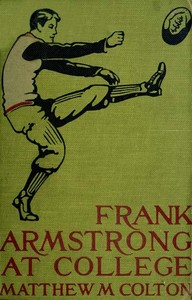
This digital edition of Frank Armstrong at College — Reading Companion is described by source-level measurements including 59,870 words, 4 hr 21 min estimated reading time, and 6 detected text sections.
The text analysis averages about 16.2 words per sentence, while the detected sections provide another way to judge how the source is divided.
Project Gutenberg metadata also associates the work with “College stories,” connecting these edition facts with the source record’s subject description.
Explore this collection
These alternatives are selected using recorded categories and estimated reading time.
About 264 minutes
Fantasy Juvenile Worlds
60,619 recorded words. 3 minutes difference from this book's estimate.
View Gutenberg source #54621About 258 minutes
Fantasy Juvenile Worlds
59,269 recorded words. 3 minutes difference from this book's estimate.
View Gutenberg source #54813About 257 minutes
Fantasy Juvenile Worlds
58,975 recorded words. 4 minutes difference from this book's estimate.
View Gutenberg source #43334Search stored excerpts and compare books → Choose by your preferences →
Choices use stored catalog measurements. Estimates vary with reading speed. A shared category is a catalog label, not a claim that two books have the same argument or literary quality.
Search reads excerpt text stored with this catalog and links to its associated Gutenberg record. The connection is stored in the site database; this tool does not recheck that every excerpt is word-for-word identical to that external record. Excerpt search does not cover every chapter and does not verify historical publication dates.
Catalog snapshot checked: 2026-09-26. Coverage: 97 public books, 97 available source excerpts.
Calculated from edition completeness, EPUB availability, text structure and catalogue metadata. Not a user rating.
Total of 100 points, scaled to a 2.5-5.0 range. Editions with an empty description or a missing EPUB file are not scored.
Public-domain source text
The source text is kept in the dedicated reader, separate from this catalogue record and its commentary.
The novel opens with a scene of controlled chaos: a crowd of students surging around College and Chapel streets on the night of the traditional Freshman Rush. The description emphasizes the physical mass of the throng—'bronzed giants,' 'shouldered their way,' 'chatter and hum of many voices'—and the way the crowd is stratified by class, with Freshmen keeping 'aloof from the upper class-men.' This opening establishes a pattern of movement and grouping that recurs throughout the excerpts, whether in football plays, shipboard promenades, or the orchestrated pranks of the Codfish.
The narrative repeatedly uses crowd scenes to mark transitions between episodes. The opening rush is followed by a 'brush with the police,' then a prank involving the Codfish creating news. Later, the voyage to London introduces a new social crowd on shipboard. These gatherings are not mere background; they are arenas where status is negotiated. The Freshmen are 'tried out' in the rush; the football team is tested in games; the shipboard society is manipulated by the Codfish's fake subscription list. Each crowd scene functions as a microcosm of the larger social order, with characters moving through them to gain or lose standing.
The excerpts are filled with verbs of physical action: 'surged and billowed,' 'off like the wind,' 'pranced up,' 'jumped up.' Even the letter about the Codfish's supposed 'mental aberration' is a verbal projectile. The football forward pass that opens the book—'caught it cleanly and was off like the wind'—is echoed in the quick, darting movements of characters on the ship. The Codfish 'gritting his teeth' and later 'prancing' suggests a coiled energy that often erupts into pranks or confrontations. This kinetic language reinforces the sense that the world of the novel is one of constant, often competitive, motion.
Among the characters, the Codfish stands out for his ability to generate narrative momentum. His scheme to embarrass McGregor by forging a subscription list for the 'Widows and Orphans of Sailors' fund is a small, self-contained plot that reveals his cunning and his willingness to manipulate social codes. The episode moves from the letter to the steward's collection to McGregor's confusion, all within a few pages. The Codfish's actions are not merely comic relief; they drive the episodic structure, creating a ripple effect that involves the whole shipboard community. His 'fires of revenge' are a recurring motive, suggesting that such small-scale conflicts are the engine of the story.
The excerpts show a clear geographical shift from the Yale campus to a transatlantic voyage, but the social dynamics remain consistent. The same competitive, hierarchical structures that govern the Freshman Rush and football tryouts reappear on the ship, where the Harvard-Yale rivalry continues in the form of flirtation and pranks. The shipboard setting allows for a more enclosed, almost theatrical space where characters can be observed and manipulated. The steward's collection scene, with its careful copying of names and the subsequent confrontation, mirrors the earlier 'making the eleven' tryouts in its emphasis on lists, selection, and public performance. This structural parallel suggests that the novel uses movement between settings to explore variations on a theme of social competition.
Readers approaching Frank Armstrong at College will find a narrative that prizes incident over introspection. The excerpts suggest a book built from discrete, often humorous episodes held together by a cast of recurring characters and a consistent interest in the rituals of college life—athletic, social, and occasionally underhanded. Pay attention to how the author uses crowds and physical movement to signal shifts in tone and plot, and to the way the Codfish’s schemes, however petty, reveal the underlying codes of loyalty and rivalry that bind the group together.
There’s something about the push of students through Yale’s old gates that stays with you, even long after you’ve put the book down. A crowd is just a place where everyone moves at once. I remember feeling that same pulse in the jungle paths of Ken Ward, where urgency turns strange. Somewhere between those pages, motion becomes memory, and the noise quiets. Ken Ward in the Jungle — Edition Insights brings that back, quietly.
Your answers remain private and are stored only in this browser.