About 182 minutes
The Gayton Scholarship: A School Story — Themes and Context
Fantasy Juvenile Worlds
41,702 recorded words. 4 minutes difference from this book's estimate.
View Gutenberg source #46020
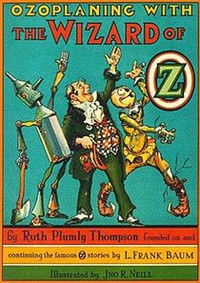
This digital edition of Ozoplaning with the Wizard of Oz — A Reader’s Guide is described by source-level measurements including 40,904 words, 2 hr 58 min estimated reading time, and 6 detected text sections.
The text analysis averages about 15.0 words per sentence, while the detected sections provide another way to judge how the source is divided.
Project Gutenberg metadata also associates the work with “Oz (Imaginary place) -- Juvenile fiction,” connecting these edition facts with the source record’s subject description.
Explore this collection
These alternatives are selected using recorded categories and estimated reading time.
About 182 minutes
Fantasy Juvenile Worlds
41,702 recorded words. 4 minutes difference from this book's estimate.
View Gutenberg source #46020About 183 minutes
Fantasy Juvenile Worlds
42,062 recorded words. 5 minutes difference from this book's estimate.
View Gutenberg source #40502About 186 minutes
Fantasy Juvenile Worlds
42,574 recorded words. 8 minutes difference from this book's estimate.
View Gutenberg source #43677Search stored excerpts and compare books → Choose by your preferences →
Choices use stored catalog measurements. Estimates vary with reading speed. A shared category is a catalog label, not a claim that two books have the same argument or literary quality.
Search reads excerpt text stored with this catalog and links to its associated Gutenberg record. The connection is stored in the site database; this tool does not recheck that every excerpt is word-for-word identical to that external record. Excerpt search does not cover every chapter and does not verify historical publication dates.
Catalog snapshot checked: 2026-09-26. Coverage: 97 public books, 97 available source excerpts.
Calculated from edition completeness, EPUB availability, text structure and catalogue metadata. Not a user rating.
Total of 100 points, scaled to a 2.5-5.0 range. Editions with an empty description or a missing EPUB file are not scored.
Public-domain source text
The source text is kept in the dedicated reader, separate from this catalogue record and its commentary.
Ruth Plumly Thompson opens Ozoplaning with the Wizard of Oz not with a journey but with the Wizard pacing his laboratory, checking a clock, and fretting over invitations. The scene establishes a domestic, almost cozy tension: the inventor anxious about his guests, the serving maid Jellia Jam counting places at a table set near a fire. The Wizard’s latest creation—an Ozoplane for “Strato-sphering”—is introduced through his own restlessness rather than a grand announcement. Thompson grounds the fantastic premise in everyday details: the fall evening is “quite cool and frosty,” and Jellia admires a tiny centerpiece house with real smoke. This blend of the wondrous and the familiar sets the tone for a story where high-altitude adventure coexists with the comforts of Oz.
The Wizard’s laboratory is a space of both invention and social obligation. Thompson shows him pacing, checking the clock, and peering into the darkening garden—a portrait of the magician as anxious host. His repeated question to Jellia—“Are you sure you told them all?”—reveals a character concerned with precision and attendance, not just magical feats. The laboratory itself, “brightly lighted” and set behind the throne room, suggests a private domain where the Wizard’s authority is practical rather than ceremonial. Jellia’s role as serving maid who “counts places” and admires the miniature house positions her as a grounded counterpart to the Wizard’s lofty experiments. This opening dynamic—inventor and assistant, grandeur and domesticity—recurs throughout the excerpts, as when the Wizard later consults a “little book” of flight entries and Jellia reports her observations matter-of-factly.
Thompson introduces a specific technological detail: the Ozpril’s magnetic compass, which tracks the Oztober’s course “provided both planes are in flight.” This device allows the Wizard to follow Jellia’s exact route, creating a parallel between the two flights. The Wizard’s logbook, with entries for “Clouds, fogs, spiked monsters,” mirrors Jellia’s terse summary—“Oh, nothing much but clouds, fog, an icecloud, and some flying airimals with spikes.” This symmetry underscores a theme of shared experience across distance. Yet the Wizard’s delay is attributed to “difference in speed,” a practical limitation that keeps the narrative from feeling too convenient. The compass and logbook are not mere props; they structure the pursuit and give the Wizard a methodical, almost scientific role. Thompson avoids over-explaining the magic, letting the mechanical details ground the fantasy.
In the Royal Pavilion of Stratovania, Thompson stages a quiet comedy of character through dialogue and action. The Scarecrow, bouncing on air cushions, invites others to join him; the Wizard stacks three cushions and stretches out, murmuring about fatigue after “sixteen hours of flying.” Dorothy curls up on a couch and falls asleep “almost before her head touched the pillows.” Jellia watches them nervously, while the Soldier with Green Whiskers declares he “wouldn’t trade one button on my uniform for all the jewels in Strut’s crown.” Each reaction reveals personality: the Scarecrow’s playful energy, the Wizard’s exhaustion, Dorothy’s easy trust, Jellia’s vigilance, and the Soldier’s loyalty to Oz over Stratovania. Thompson uses the pavilion’s air cushions and blue pillars as a backdrop for these interactions, letting the setting amplify the characters’ distinct voices.
Thompson’s dedication to illustrator John R. Neill—“Bows, cheers and heartfelt appreciation!”—hints at the collaborative spirit behind the book. Readers attentive to the interplay of text and image will find Neill’s drawings amplifying the merriment Thompson mentions in her preface. The excerpts suggest a narrative that rewards attention to small details: the Wizard’s logbook, Jellia’s counting, the Soldier’s uniform buttons. These concrete elements anchor the story’s airborne whimsy, offering a reading experience that balances invention with character-driven humor.
Reading about the Wizard’s airborne contraptions, I remembered my grandfather’s old atlas, where I once traced smuggling routes by lantern light. That same thrill of hidden purpose—the machine’s cleverness, the sailors’ quiet defiance—came back. It’s odd how Ozoplaning and Jack Hardy: A Story of English Smugglers in the Days of Napoleon — Background and Themes both feel like afternoons spent inventing private adventures, no urgency, just wonder.
Build a private reading journal entry for this title.